

How to Actually Buy a House in Rochester Right Now
The Short Version
- Rochester has a median home price around $225,000 — less than half the national median — but the market is brutally competitive, with only 0.3 months of housing supply in early 2026.
- Homes are selling in a median of 8 days and closing at an average of 111.9% of list price, with 65% going above asking.
- Home values in Monroe County have risen 75% since 2019, and Realtor.com projects 10.3% price growth and 5.3% sales growth for 2026 — the strongest combined projection in the country.
- This guide covers what buyers actually need to know: how to compete without waiving everything, which neighborhoods still have opportunity, and what to watch out for.
- The good news is real — Rochester is still one of the most affordable cities its size in the country. The challenge is moving with speed and precision to get in.
The Headline vs. the Reality

The Headline vs. the Reality
The national rankings aren't wrong. Rochester's median home price sits around $225,000–$256,900 — compared to a national median of roughly $415,000. The average Rochester homeowner spends about 19.1% of their monthly income on their mortgage, well below the 30% threshold economists use to define housing cost burden. And Realtor.com forecasts 10.3% home price growth and 5.3% sales growth for the Rochester metro in 2026 — the strongest combined growth projection of any market in the country.
What those headlines don't tell you is that you'll be competing for a sliver of available inventory in a city where demand has grown faster than supply for several years running. In early 2026, Rochester had just 0.3 to 0.52 months of housing supply — a balanced market requires 5 to 6 months. There were as few as 84 homes available in the city in February 2026. Properties are selling in a median of 8 days and closing at an average of 111.9% of list price. About 65% of homes are selling above asking price.
Home values in Monroe County have risen 75% since 2019, according to Mark Siwiec, broker/owner of Elysian Homes by Mark Siwiec and Associates — a figure he cited in the Rochester Business Journal in December 2025. "I've known [a house] for the better part of fifty years," Siwiec told the publication, "and it's at a number now that even seven years ago, when it sold, we never would have thought it would be at."
The good news: Rochester's prices, even after that appreciation, are still a fraction of what you'd pay in comparable cities. The challenge is that you have to move with speed and precision to get in.
What the Numbers Actually Look Like in 2026
What the Numbers Actually Look Like in 2026
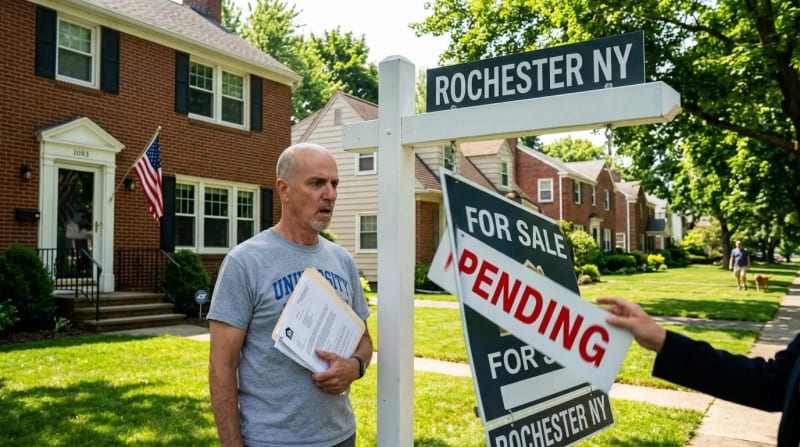
According to Team Hilbert's February 2026 market update, the Rochester housing market is "structurally undersupplied," with new listings being absorbed almost as quickly as they arrive. The median sold price has risen to approximately $225,000, while property values are up 6.7% year-over-year. On the competitive end, Redfin data shows that the hottest homes are going pending in around 7–8 days and selling for up to 29% above list price.
The national picture gives Rochester's numbers important context. The National Association of Realtors reported that in 2025, the average age of a first-time homebuyer nationally hit an all-time high of 40 years old — a number that reflects how locked out younger buyers have become in many markets. Rochester's average first-time buyer age is estimated at 30 to 33, a meaningful gap that reflects the city's relative accessibility even amid tight inventory.
Mortgage rates, which peaked at 7.26% in January 2025, have moderated to approximately 6.23% by late 2025, with forecasts suggesting rates will remain in the low-to-mid 6% range through 2026. Don Simonetti, Jr., president of the Greater Rochester Association of REALTORS (GRAR), told the Rochester Business Journal in December 2025 that he expects 2026 to look much like 2025 — "continued strong demand, tight supply and good news for sellers."
For buyers, that means it's still hard. But it's not impossible if you prepare correctly.
Get Your Financing Sorted Before You Look at a Single House
Get Your Financing Sorted Before You Look at a Single House
The most common mistake first-time buyers make in Rochester right now is treating mortgage pre-approval as a formality to take care of when they find something they like. In a market where homes go under contract in 8 days and routinely receive multiple offers on the first weekend, showing up without pre-approval means you're not in the game.
More importantly: standard pre-approval is no longer enough in the most competitive price ranges. Real estate advisors and lenders increasingly distinguish between a basic pre-approval letter — which is a lender's estimate based on a quick review — and a fully underwritten pre-approval (sometimes called a Verified Approval or Pre-Commitment), where your credit, income, and assets have already been reviewed by an underwriter. The latter tells a seller that your financing is essentially confirmed. In a multiple-offer situation, that difference can be decisive.
Steps to get your financing ready:
Know your numbers before you talk to a lender. Pull your credit report and check your score. Most conventional loans require a minimum score around 620; to get the best rates, you'll want to be above 740. Your debt-to-income ratio matters too — most lenders want to see total monthly debt obligations (including your future mortgage) at or below 43% of gross monthly income.
Get fully underwritten pre-approval, not just a pre-qual letter. Ask the lender explicitly: "Will this be a fully underwritten approval?" A pre-qualification is just a lender's estimate. You want documentation reviewed before you're in a bidding war.
Understand what you can actually afford vs. what you're approved for. Lenders will often approve you for more than you're comfortable paying. Run your own budget first — account for property taxes (which vary significantly by municipality in Monroe County), homeowner's insurance, and any immediate maintenance costs.
The Money You Might Not Know About

The Money You Might Not Know About
Rochester has one of the strongest ecosystems of first-time buyer assistance programs in upstate New York. Most buyers don't fully explore what's available before they start shopping — and leave real money on the table.
City of Rochester Home Purchase Assistance Program (HPAP) The City of Rochester offers grants of up to $8,000 for closing cost assistance to income-eligible first-time buyers purchasing within city limits. The home must be a one-to-four-family property. Buyers must have a household income below 120% of the HUD median family income, complete pre- and post-purchase homebuyer training, and obtain eligibility paperwork through a virtual meeting with a City Homebuyer Services counselor before executing a purchase offer. The HPAP is compatible with most other grant programs including the Homebuyer Dream Program and SONYMA. Contact: homebuyer@cityofrochester.gov or (585) 428-6888.
Homebuyer Dream Program (HDP) — Federal Home Loan Bank of New York The FHLBNY allocated $31,670,000 for the 2026 HDP rounds on February 9, 2026, with 110 participating member lenders. The program provides grants of up to $30,000 per household for down payment, closing costs, and homebuyer counseling services, for buyers at or below 80% of Area Median Income. A companion program, HDP Plus, extends eligibility to households earning between 80% and 120% AMI with grants up to $30,000. These funds are first-come, first-served and go quickly. Work with a participating lender early in your process to secure your place in the round.
SONYMA — State of New York Mortgage Agency SONYMA offers two core first-time buyer mortgage programs available throughout New York State, both as 30-year fixed-rate mortgages with low down payment requirements:
- Achieving the Dream — the lowest available SONYMA rate, designed for lower-income buyers. Requires as little as 1% cash contribution from the buyer.
- Low Interest Rate Program — broader income eligibility, competitive rates, down payment as low as 1–3% depending on property type.
Both programs can be paired with SONYMA's Down Payment Assistance Loan (DPAL) — a zero-interest loan, forgiven after 10 years, for up to 3% of the purchase price (capped at $15,000). The DPAL Plus program offers up to $30,000 for buyers at or below 60% AMI.
SONYMA programs can be layered with local grants like HPAP and HDP, giving city buyers access to a meaningful stack of assistance. Consult a SONYMA-approved lender in Rochester (Genesee Regional Bank, Family First Credit Union, and others participate) to model what combinations you may qualify for.
Monroe County Down Payment Assistance Monroe County Community Development offers grants for down payment and closing cost assistance to income-eligible first-time buyers purchasing in suburban Monroe County towns and villages (not the City of Rochester). Contact The Housing Council at (585) 546-3700 for current program details and eligibility.
Employer-Assisted Programs If you work at the University of Rochester, you may be eligible for up to $20,000 toward the purchase of a primary residence within city limits, through the University's Home Ownership Incentive Program — a grant forgiven over five years with occupancy and employment commitments. The program requires household gross income under $155,000 and participation in the City's EAHI program. Other major employers in the region participate in the Employer Assisted Housing Initiative (EAHI); check with your HR department.
HOME Rochester For income-qualified buyers, the Rochester Housing Development Fund Corporation rehabilitates vacant homes in city neighborhoods and sells them to low-and-moderate income first-time buyers through the HOME Rochester program. These are move-in ready, single-family homes with built-in affordability assistance. See homerochester.org for qualification details.
How to Write an Offer That Wins
How to Write an Offer That Wins
In a market where the average home sells for 111.9% of list price and 65% of homes go above asking, making a competitive offer is less about luck and more about preparation and strategy.
Offer above asking — and know your ceiling before you walk in. Many Rochester buyers — especially in the $150,000–$300,000 range — find themselves in multiple-offer situations. Go into each showing having already decided on your maximum number, so emotions don't drive you past your budget in the moment. Use an escalation clause to let your offer automatically outbid competing offers up to your cap — this keeps you competitive without requiring you to start at your ceiling.
Appraisal gap coverage matters more than contingency waivers. When a home sells for 20%+ over asking, there is a meaningful risk that it appraises below the contract price. Many sellers require buyers to demonstrate they can cover an "appraisal gap" — the difference between the appraised value and the purchase price. If you waive the appraisal contingency, you are committing to cover that gap out of pocket. Only do this if you genuinely have the cash reserves to back it up. A middle path: offer defined appraisal gap coverage — "buyer will cover the appraisal gap up to $X" — which gives the seller confidence without requiring you to waive the contingency entirely.
Consider an informational-only inspection rather than waiving inspection entirely. Mark Siwiec of Elysian Homes noted in a HomeLight article that removing contingencies can help an offer stand out "even if it means not offering the highest price." But waiving inspection entirely is a significant risk on older Rochester housing stock (the median home in the city was built in 1966). A practical alternative: offer an "informational only" inspection clause, where you retain the right to cancel for major defects — structural failure, mold, sewer issues — but agree not to use minor findings as a negotiating lever. This reassures sellers while protecting you from genuine disasters.
Shorten your contingency timelines. If you're keeping your mortgage contingency, offer a shorter commitment period — 21 days instead of 45. This limits the time the seller's home is off the market and signals confidence.
Larger earnest money deposit signals commitment. A standard earnest money deposit in many markets is 1% of the purchase price. Offering 2–3% demonstrates you're serious and won't walk away casually.
Match the seller's preferred closing timeline. Find out what the seller needs — a quick 30-day close, or time to find their next home — and accommodate it if you can. Flexibility on occupancy dates can be as valuable as money in some situations.
Where to Look: Neighborhoods and Suburbs Worth Knowing
Where to Look: Neighborhoods and Suburbs Worth Knowing
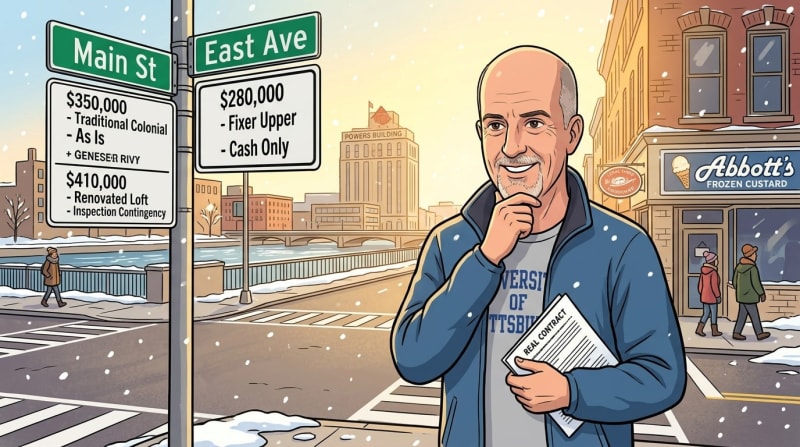
The Rochester region is highly localized. Monroe County does not behave like one market — it's dozens of micro-markets with different price points, school districts, tax rates, and buyer competition. Here is an honest overview:
Within the City of Rochester
Park Avenue / ABC Streets — Among the most desirable city neighborhoods. Walkable, close to restaurants, coffee shops, and Cobbs Hill Park. Strong community associations. Highly competitive; homes here go quickly and often well above asking.
North Winton Village — Consistently cited as one of the most popular neighborhoods for first-time buyers, bordering Irondequoit, Penfield, and Brighton. When homes list here, they often receive offers within hours.
South Wedge — South of downtown, walkable to bars, coffee shops, and unique restaurants. A good option for buyers who want a city lifestyle at a lower price point than Park Ave.
19th Ward — Close to the University of Rochester and Strong Memorial Hospital. Historic homes, access to Genesee Valley Park. More price-accessible than east-side neighborhoods.
For city purchases, remember that most grant programs (HPAP, EAHI, University of Rochester employer assistance) are only available for homes within city limits — which can meaningfully reduce your net cost compared to a comparable suburban purchase.
In the Suburbs
Irondequoit — One of the most recommended first-time buyer suburbs. Closest suburb to downtown (approximately 10 minutes), affordable older housing stock (typically 1940s–1960s colonials, capes, and ranches), and access to Lake Ontario. Split between two school districts: West Irondequoit and East Irondequoit. Generally more affordable than east-side suburbs.
Greece — Southwest of the city, one of the most budget-accessible suburbs in Monroe County. Good access to the lake. Less walkable than Irondequoit, but stronger value-per-square-foot.
Gates / Chili — Among the most affordable suburb options, with newer development alongside older housing stock. Quieter, more suburban feel. Good access to I-490.
Brighton — Inner-ring suburb adjacent to the University of Rochester. Top-rated schools (Niche gives Brighton an "A+" grade), walkable pockets, and a strong community. Higher taxes and home prices than most Monroe County options, but among the most competitive suburbs to get into.
Penfield / Fairport / Webster — East-side suburbs with strong school districts, more space, and a slightly more spread-out feel. Tend to attract family buyers willing to pay a premium for schools and parks. Longer commutes to downtown.
One important note on taxes: Property taxes in New York vary significantly by municipality and school district — this can change your monthly payment by hundreds of dollars on a similar purchase price. Always calculate the full cost including taxes when comparing options across suburbs.
The Mindset That Gets You Through It
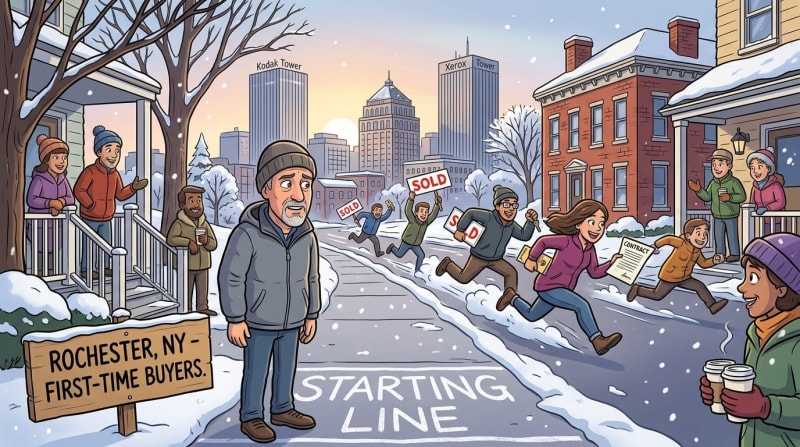
The Mindset That Gets You Through It
Nationally, only 21% of home purchases in 2025 were by first-time buyers — far below the historical norm of 37–38%, according to the National Association of Realtors. The people buying houses right now are largely people who already own one, leveraging existing equity in a market where patience and capital dominate.
First-time buyers are succeeding in Rochester. But they tend to share a few things: they started their financing process earlier than they thought necessary, they found an agent who actually knows the neighborhood they're targeting (not just the city broadly), and they made peace with losing a few houses before winning one.
If you're in the rental-to-ownership transition that the city's housing economy makes genuinely hard, the message is this: Rochester is still one of the most realistically accessible cities in the country for people who actually want to own here. The median home price is 63% below the national median. The commute time is 21 minutes. The community is real. The city is worth fighting for.
The fight is harder than it used to be. That doesn't mean it isn't worth having.
What Would Actually Fix This?
Buying strategies and assistance programs help individual buyers navigate the market. They don't fix the market. And Rochester's housing shortage — like most American cities' — is fundamentally a supply problem.
The Rochester Beacon recently published a bipartisan look at the question, with a liberal and conservative voice both arriving at roughly the same diagnosis: demand has grown faster than supply for years, and the private sector alone hasn't filled the gap. The disagreement is about why and what to do next — zoning reform, density incentives, modular construction, public investment — but the underlying math is not in dispute.
New York State has started to push back on the inertia. Governor Hochul's Pro-Housing Communities program has certified municipalities committed to zoning reform and pro-housing policies, making them eligible for a share of up to $650 million in state discretionary funding. Several Monroe County communities have joined, including Irondequoit, Henrietta, and the City of Rochester itself. The city is also deploying the Rochester Housing Stability Fund, which has assisted over 380 households as of early 2026.
None of this moves fast enough to change what you'll face shopping for a home this spring. But it's worth knowing the machinery is at least moving — and that Rochester has more political will around this issue, from both sides of the aisle, than most cities its size.
What would it take for Rochester to build its way out of this? That's a question worth the community's sustained attention — not just at election time, but at every zoning board meeting and planning commission in Monroe County.
Sources: Realtor.com 2026 Housing Market Rankings; Rochester Business Journal (December 2025); Team Hilbert / Keller Williams Greater Rochester (February 2026 market update); Houzeo Rochester Market Data (2026); Redfin Rochester Housing Market (February 2026); City of Rochester Home Purchase Assistance Program; Federal Home Loan Bank of New York Homebuyer Dream Program (February 2026); SONYMA / NY Homes and Community Renewal; Greater Rochester Association of REALTORS (GRAR); The Mortgage Reports (February 2026); Rochester First / WROC (January 2026); Rochester Beacon Counterpoint (April 2026).
Content ID: 1TAVtpDYnFwFZK8kYYGJHVUv
See an error? Tell us.

Comments
Share with the Community