
Bull's Head Rochester: The 200-Year History Behind the City's Biggest Neighborhood Comeback
The Short Version
- Bull Head gets its name from a painted sign on a tavern that stood at Genesee Street and Buffalo Road sometime between 1808 and 1813 — and the name has never left.
- In 1857, three Daughters of Charity arrived in Rochester with fifty cents between them and established what became St. Mary Hospital in two dilapidated stables in the neighborhood.
- Bull Head is now at the center of the biggest neighborhood revitalization effort in Rochester, driven by significant investment in the West Main corridor.
- This piece traces 200 years of history — cattle markets, hospitals, immigration waves, urban renewal, and what is happening on those blocks right now.
- If you want to understand Rochester west side, this is where to start.
A Crossroads from the Beginning
A Crossroads from the Beginning
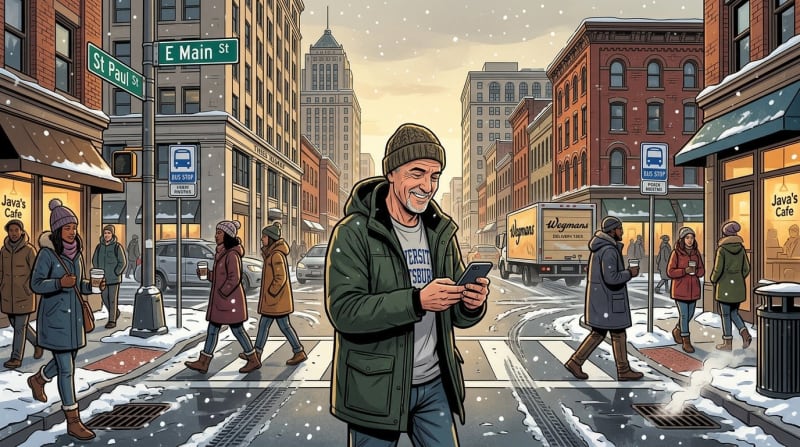
The name comes from a sign. Sometime between 1808 and 1813, a wooden tavern stood at the intersection of Genesee Street and Buffalo Road — what is now West Main Street — with a painted bull's head hanging from a post on the roadside. Genesee Street and Brown Street provided passage north and south. Buffalo Road ran west toward Batavia and beyond. The tavern sat at the convergence of all of it, and travelers heading to and from the young village of Rochester made it a regular stop. (Rochester Public Library Local History, January 2019)
Two New England settlers named Derrick Sibley and Joseph Field saw something bigger in the location. In 1827, they replaced the wooden tavern with a three-story stone building and set about establishing a cattle market modeled on the Brighton Market outside Boston. Local legend holds that cattle bound for the Rochester market were encouraged to drink from a nearby salt-laden spring, inflating their weight before reaching the scales. The market did not survive — by 1831, Sibley and Field had moved on to other ventures, and Field would later serve as Mayor of Rochester in 1848 — but the name stuck. (Rochester Public Library Local History, January 2019)
The stone building that replaced the tavern went on to serve as a water cure practice in the 1840s under a physician who billed himself as a "Magnetic Physician" and treated ailments using hydropathy and what he called his Magnetic Remedies. By 1854, he had moved on, and the building passed into new hands again. (Rochester Public Library Local History, January 2019)
Then, in 1857, three women arrived in Rochester with fifty cents between them.
They were members of the Daughters of Charity, and they had been sent to establish a hospital. Area residents donated bedding, supplies, and money. The sisters set up in two dilapidated stone stables in the Bull's Head neighborhood. Their first patient arrived on September 15, 1857. St. Mary's Hospital was incorporated four days later. By the end of their first year, the sisters had admitted 250 patients, pledging to treat the poor for free and to serve people of any faith. (Catholic Courier, October 2007)
During the Civil War, St. Mary's was officially designated a government hospital in 1863, receiving thousands of Union soldiers for treatment. The stone tavern building that stood nearby housed overflow patients. After the war, it became an orphanage. A new orphanage building went up beside it in 1871, and the original tavern structure was repurposed as a parochial school. The old stone building that had been a tavern, a water cure, and a Civil War overflow ward finally came down in 1909 to make room for the orphanage's expansion. The orphanage itself was later demolished to make way for Bull's Head Plaza, which opened in the early 1950s. (Rochester Public Library Local History, January 2019)
For two centuries, this intersection had been where Rochester put the things it needed most.
How a Neighborhood Gets Left Behind
How a Neighborhood Gets Left Behind
Understanding the decline of Bull's Head requires understanding what happened to Rochester's west side more broadly — and what happened to Rochester itself.
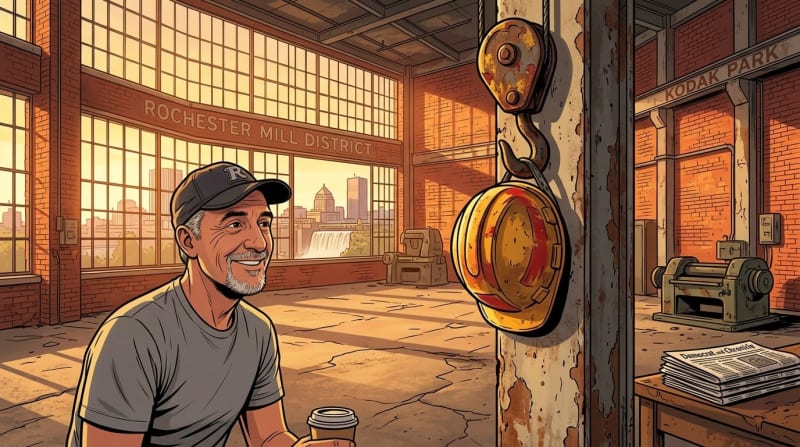
By the early 1980s, Kodak, Xerox, and Bausch & Lomb collectively employed roughly 60 percent of Rochester's workforce. Kodak in particular was known for its cradle-to-grave investment in employees — pensions, profit-sharing, stable middle-class wages for generations. What those arrangements also produced, quietly and structurally, was a city organized around the fortunes of a few corporations. When those corporations declined, the neighborhoods least protected by wealth and homeownership took the hardest fall. (Living Cities Needs Assessment, 2022)
The fall had roots going back further. Beginning in the 1930s, federal Home Owners' Loan Corporation maps designated much of Rochester's urban west side as "hazardous" — coded red — which directed federal mortgage insurance toward the suburbs and away from city neighborhoods. Lending followed the maps. In the early 1990s, a community reinvestment coalition found that white low-income households in Rochester received four times as much mortgage lending as middle-income Black households. Homeownership, and the intergenerational wealth it produces, was structurally withheld from the neighborhoods that needed it most. (Empire Justice Center / NCRC, 2020)
By the time Rochester's manufacturing economy collapsed — Kodak filed for bankruptcy in 2012, and manufacturing jobs in the city declined by 40 percent between 2000 and 2010 — Bull's Head had experienced decades of compounding disinvestment. (Living Cities Needs Assessment, 2022) The city's own press release, issued when it announced the Dawson Company as the Bull's Head developer in 2021, described the neighborhood as struggling with the effects of "more than 50 years of institutional racism, resulting in a high concentration of poverty, disinvestment and environmental contamination." (City of Rochester, June 2021)
The Rochester Beacon, reporting on the project in 2024, noted that the poverty rate in the Bull's Head area had reached twice that of Monroe County. (Rochester Beacon, January 2024) Over 60 potential brownfield sites had been identified within the project boundary. (City of Rochester, undated) Revitalization plans had been floated as far back as 1969, but were consistently stymied by cuts to federal funding and the absence of a committed development partner. (Rochester Beacon, January 2024)
This is the context behind the construction equipment that showed up last week.
Seventeen Years of Trying
Seventeen Years of Trying
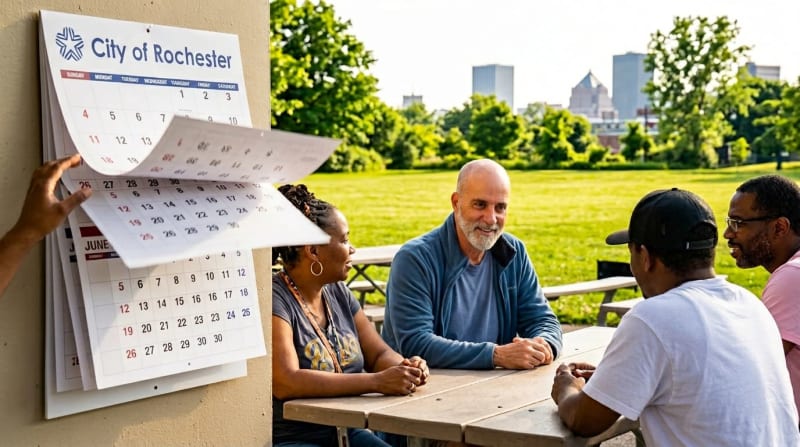
The current effort began in September 2009 with a community design workshop. Residents showed up. They described what the neighborhood needed — not in the abstract language of planning documents, but in the practical terms of people who had watched the corner deteriorate for decades. The city listened, at least enough to keep the process alive. (City of Rochester, undated)
Progress was slow. A pre-nomination study identified brownfield conditions across the site. An Urban Renewal Area was designated. In 2017, the city expanded the eligible area south of West Main Street. In 2018, Rochester City Council approved the Bull's Head Urban Renewal Plan, which gave the city stronger tools to address blight and assemble land. By 2014, the city had committed more than $10 million from its Capital Improvement Program to predevelopment work — land acquisition, environmental remediation, site preparation. (City of Rochester, undated)
In July 2020, the city issued a Request for Qualifications for a private development partner. After reviewing submissions, visiting comparable projects in other cities, and conducting developer interviews, the city selected a team led by the Dawson Company, an Atlanta-based minority-owned mixed-use developer with a track record in urban revitalization. The full development entity, named DevelopROC, brought together Brinshore Development of Chicago, Shift Capital of Philadelphia, USC of Rochester, and the Oughtness Group of Atlanta. Several members of the team had personal connections to the 19th Ward neighborhood adjacent to Bull's Head. (City of Rochester, June 2021; Rochester Beacon, January 2024)
Dana Miller, Rochester's commissioner of neighborhood and business development, told the Beacon that his involvement in Bull's Head revitalization efforts dated back to 1995, when the effort was known as the Bull's Head Community Development Corp. Thirty years later, he was still at it. (Rochester Beacon, January 2024)
What Is Actually Being Built

What Is Actually Being Built
The first visible piece is the street project. The $17.9 million Bull's Head Street Improvements Project — funded by a mix of federal, state, city, and Monroe County dollars, along with New York State Department of Environmental Conservation funds for bicycle infrastructure — is redesigning the intersections where West Main Street meets Genesee and Brown Streets, and where West Main meets Chili Avenue, West Avenue, and York Street. (City of Rochester, March 2026)
The design follows a complete streets approach, meaning it is built for everyone: pedestrians, cyclists, and drivers. The reconfigured intersections are intended to reduce conflict points, calm traffic, and improve visibility and accessibility for disadvantaged and vulnerable populations in the neighborhood. The work is explicitly tied to the city's ROC Vision Zero initiative, which aims to eliminate traffic fatalities and serious injuries on Rochester streets. Construction on the first phase is expected to complete by summer 2026. (City of Rochester, March 2026; Rochester Beacon, March 2026)
Running alongside the street work is the Bull's Head Empowerment Center, a $23.6 million adaptive reuse project at 160 Clifton Street led by USC Builds, a certified Minority and Women-Owned Business Enterprise. The building will house workforce development programming, nonprofit services, local businesses, a 24-hour daycare operated by Action for a Better Community, and a proposed coffee shop. It is expected to be operational in spring 2027. (Governor Hochul's office, June 2025)
The broader DevelopROC development plan envisions mixed-use, mixed-income housing across 12 acres of city-owned land — affordable homeownership units, market-rate and affordable rental housing, and commercial space. The plan commits to a minimum of 20 percent of all units being affordable to individuals at or below 60 percent of area median income. ESL Federal Credit Union is already in place as an anchor institution. Daniel Pemberton of the Dawson Company has said that the scale of development — across multiple housing types and income levels — is specifically calibrated to what the company has found is required for sustainable neighborhood change. (Rochester Beacon, January 2024)
The Empowerment Center is one part of a broader $80 million Regional Revitalization Partnership investment the state has committed to Rochester, which also includes support for waterfront projects like ROC the Riverway, High Falls State Park, and targeted small business assistance along commercial corridors in the city's most disadvantaged neighborhoods. The total Bull's Head revitalization vision, public and private combined, is a $350 million commitment. (Governor Hochul's office, June 2025)
Why This Is a Story About More Than One Neighborhood
Why This Is a Story About More Than One Neighborhood
John Majors, principal of the Oughtness Group and a man who grew up on Burlington Avenue near Bull's Head, put it plainly at a public information meeting in 2024. He said he wanted a young person who grew up in the neighborhood to one day walk across the stage at a university with every accolade. (Rochester Beacon, January 2024)
That is not the language of a real estate transaction. It is the language of a community that has been waiting a long time for the city to show up.
Bull's Head has always been a gateway — to Rochester's downtown, to its west side, to its sense of what it thinks it owes its own residents. The cattle market failed in 1831. The water cure closed in 1854. The orphanage came and went. The 1950s plaza held on for decades while the neighborhood around it hollowed out. Revitalization plans were written and shelved in 1969, and again, and again.
What is different now is that equipment is moving and streets are being closed. The planning phase is over. What happens next — whether the housing gets built, whether the Empowerment Center becomes what it is meant to become, whether the intersection at West Main and Genesee turns into something a resident can be proud of — is the real story, and it is still being written.
Rochester has a long history of believing in its own potential and a complicated relationship with following through. Bull's Head, more than almost any other block in the city, has absorbed the cost of that gap. The people who stayed are owed something more than a press release.
A Resource: Following the Project
A Resource: Following the Project
For those who want to track the Bull's Head revitalization as it unfolds, the City of Rochester maintains a dedicated project page through its Department of Neighborhood and Business Development, as well as a separate page through the Department of Environmental Services for the street improvements specifically. DevelopROC maintains its own project page. The Rochester Beacon has published some of the most detailed reporting on the development plan and is worth bookmarking for updates. The Rochester Public Library's Local History blog, published in partnership with the Office of Rochester and Monroe County History, is the best single source for the neighborhood's longer arc.
Bull's Head is worth watching. It has been for two hundred years.
Content ID: mliLEzUrGYdcIo9A0jRrXA4g
See an error? Tell us.

Comments
Share with the Community