
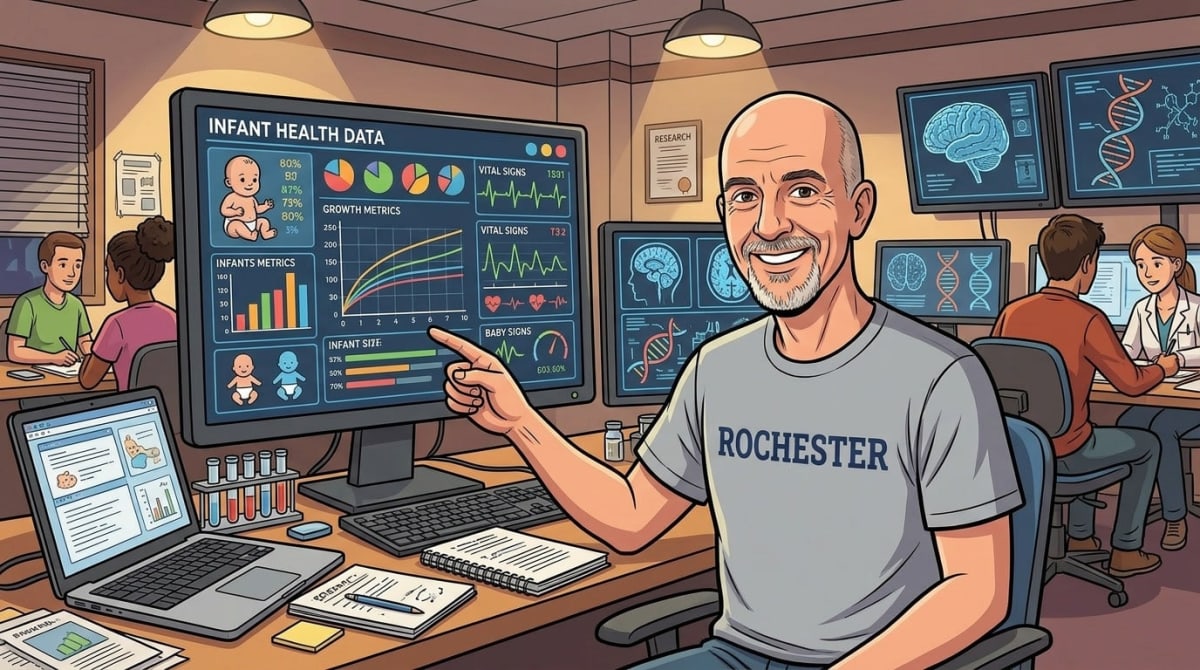
Rochester Researchers Built an AI That Could Save Premature Babies' Lungs
The Short Version
- University of Rochester researchers published an AI model in the Journal of Pediatrics that substantially outperforms existing online calculators at predicting which premature babies will develop severe bronchopulmonary dysplasia.
- A 2019 update to NICHD BPD grading criteria made existing prediction calculators inaccurate — the gap the Rochester team's machine learning model directly addresses.
- Unlike static calculators, the Rochester model tracks disease trajectory in real-time across detailed EHR data, identifying specific windows when earlier intervention could change outcomes before lung damage becomes irreversible.
- The cross-disciplinary team — Dr. Andrew Dylag (Neonatology), Albert Arendt (Engineering), Jiebo Luo (Computer Science), Xing Qiu (Biostatistics), and Jack Chang (Research Informatics) — reflects what URMC's infrastructure makes possible in Rochester.
- Children with severe BPD face estimated respiratory rehospitalization rates approaching 50% in their first two years; earlier trajectory prediction is the mechanism for reducing that burden before severity is locked in.
There is a particular tension that settles over a NICU. Part hope, part waiting, part the quiet effort of everyone in the room not to promise anything they can't keep. For the smallest patients — babies born months before their lungs were ready — one question hangs over every shift: which babies will develop serious lung disease, and is there anything left to do about it?
A team of researchers at the University of Rochester Medical Center has developed a machine learning model that brings that question closer to an answer. Published in 2026 in the Journal of Pediatrics, the study shows their AI model can predict the trajectory of bronchopulmonary dysplasia — the chronic lung disease that commonly strikes extremely premature infants — with substantially greater accuracy than the static online calculators neonatologists currently rely on. It is the kind of research that starts in a ward down the hall and could eventually change what happens in NICUs everywhere.
What Is Bronchopulmonary Dysplasia — and Why Does It Matter?
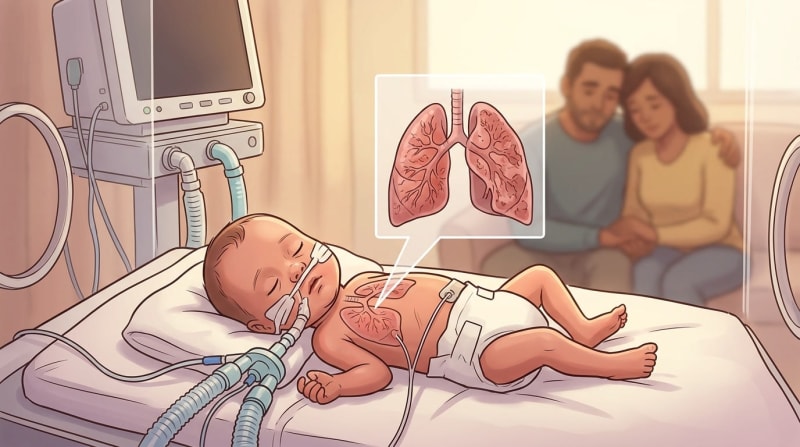
What Is Bronchopulmonary Dysplasia — and Why Does It Matter?
Bronchopulmonary dysplasia — BPD — develops when a premature baby's underdeveloped lungs are exposed to the very interventions keeping them alive. Mechanical ventilation and supplemental oxygen are lifesaving in the NICU, but they also stress tissue that isn't ready. Over days and weeks, that stress can produce chronic inflammation and scarring. The result is a lung that doesn't develop as it should.
BPD is one of the most common serious complications of extreme prematurity. According to outcomes data from the NICHD Neonatal Research Network, the risk rises sharply at the lowest gestational ages — the babies born earliest carry the heaviest burden.
The severity matters enormously. A baby with mild BPD may need supplemental oxygen at home for a few months and largely grow out of it. A baby with severe BPD may face pulmonary hypertension, repeated respiratory hospitalizations in early childhood, elevated rates of asthma, and neurodevelopmental challenges that extend into school age. These are not edge cases — they are documented patterns across the research literature on premature infant outcomes.
What would it change for a family to know — early enough to act — where their baby's lungs are headed?
The Problem With Existing Prediction Tools
The Problem With Existing Prediction Tools
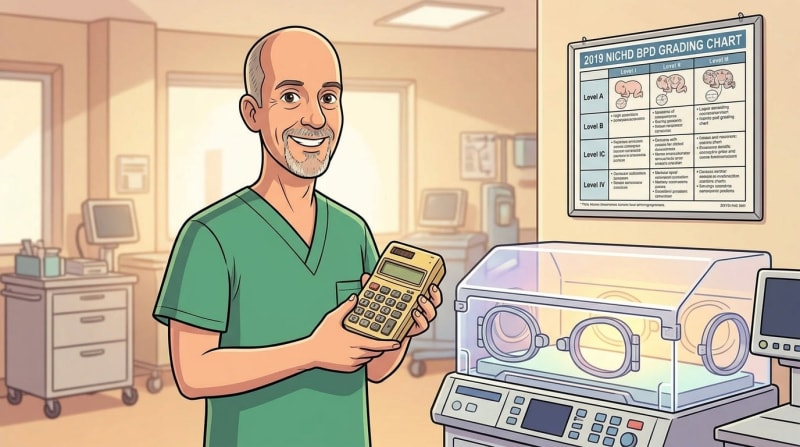
Neonatologists haven't been working blind. Online calculators for estimating BPD risk have existed for years, giving clinicians a probability estimate based on a set of early clinical indicators. The problem is that these calculators were built on limited datasets and around an older set of clinical criteria — and the field moved underneath them.
In 2019, the National Institute of Child Health and Human Development updated the grading system used to classify BPD severity. The new classification uses Grades 1, 2, and 3 rather than the prior mild/moderate/severe framework, and the criteria for each grade changed meaningfully. Existing calculators — built around the old system — became unreliable tools for predicting outcomes under the new one. Neonatologists were left using instruments calibrated to a previous era.
The gap this created is not abstract. According to CDC National Vital Statistics data, approximately 10.4% of US births — roughly 380,000 babies — were born preterm in recent years. Among those, the most extremely premature represent a small but critically vulnerable share.
Among the approximately 28,000 babies born at fewer than 28 weeks each year, a meaningful share will develop BPD. Without a reliable prediction model calibrated to current clinical guidelines, neonatologists are making high-stakes decisions — when to escalate respiratory support, when to try a different approach, when the current path is likely to lead somewhere very hard — without a reliable map.
How the Rochester AI Model Works
How the Rochester AI Model Works
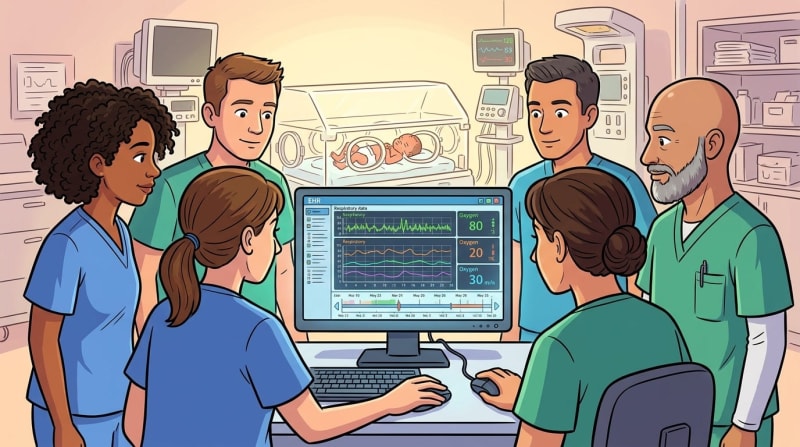
The machine learning model built by the University of Rochester AI research team operates on a fundamentally different logic than the calculators that came before it. Rather than producing a single probability at one point in time, it tracks the trajectory of disease — reading a baby's status across the clinical timeline, not just capturing a snapshot at day seven.
The model draws from detailed clinical data stored in electronic health records: respiratory support levels, oxygen requirements, lab values, imaging data, and a range of variables that existing online calculators simply don't incorporate. That depth of input gives the model a richer, more dynamic picture than a handful of static data points can provide.
Critically, the model identifies specific windows of vulnerability — moments in a baby's first weeks when a change in approach is most likely to alter the trajectory. Knowing a baby is trending toward Grade 3 BPD on day fourteen is meaningfully different from knowing the overall odds at birth. It tells the clinical team where the leverage is.
NICU length of stay is one concrete measure of what happens when disease severity isn't caught early. According to research published in Seminars in Perinatology and related neonatal outcomes literature, average NICU stays extend substantially as BPD severity increases — adding weeks to already-long hospitalizations.
The goal is not prediction for prediction's sake. It is prediction in service of intervention — giving clinicians the information they need, when they need it, to act before disease becomes irreversible.
The Team Behind It — and What Rochester Makes Possible
The Team Behind It — and What Rochester Makes Possible
This kind of research doesn't assemble itself. It requires people from different disciplines to agree on a shared problem and then actually build something together.
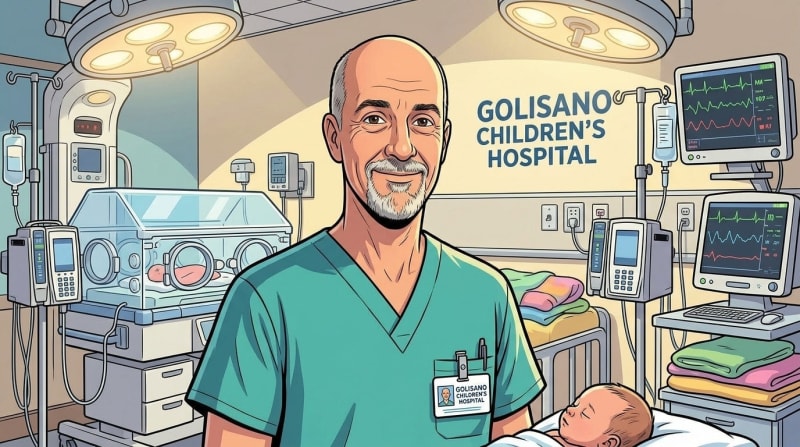
The team is led by Dr. Andrew Dylag, a neonatologist at Golisano Children's Hospital at URMC. Alongside him: Albert Arendt from Engineering, Jiebo Luo from Computer Science, Xing Qiu from Biostatistics and Computational Biology, and Jack Chang from Research Informatics. Each brought a different piece of the puzzle. Dylag brought years of watching families wait for answers at the bedside. His colleagues brought the technical tools to look for them.
URMC is one of the largest employers and research institutions in the Rochester region, and Golisano Children's Hospital is its pediatric anchor. The combination — clinical care and research infrastructure under the same roof, in the same city — creates the conditions for exactly this kind of team to form. A neonatologist alone cannot build a machine learning model. A computer scientist alone cannot identify the right clinical problem to solve. Rochester makes the introduction possible.
What gifts does a city offer when it invests in a research medical center? This is one answer: clinical need meeting technical skill, here, in a building most Rochesterians drive past without knowing what is being built inside.
What Comes Next — and What This Could Mean for Families
What Comes Next — and What This Could Mean for Families
A paper published in a peer-reviewed journal is a credential. It means the work has been examined by people who weren't rooting for it to succeed, and they found it valid. But it isn't the same as a tool in a neonatologist's hands. The gap between a published model and a clinical decision support system is where most medical AI research stalls.
The Rochester team has named that gap directly. Their stated goal is to develop decision support tools — software that neonatologists can use in real-time, applied to a specific baby on a specific day, to inform specific choices about care. The presence of Research Informatics expertise on the team suggests this was always part of the plan. The goal from the beginning was not a paper. It was a tool.
According to outcomes research published in Pediatric Pulmonology and related neonatal literature, children with severe BPD face substantially higher rates of respiratory rehospitalization in their first two years of life — underscoring precisely why predicting trajectory early matters.
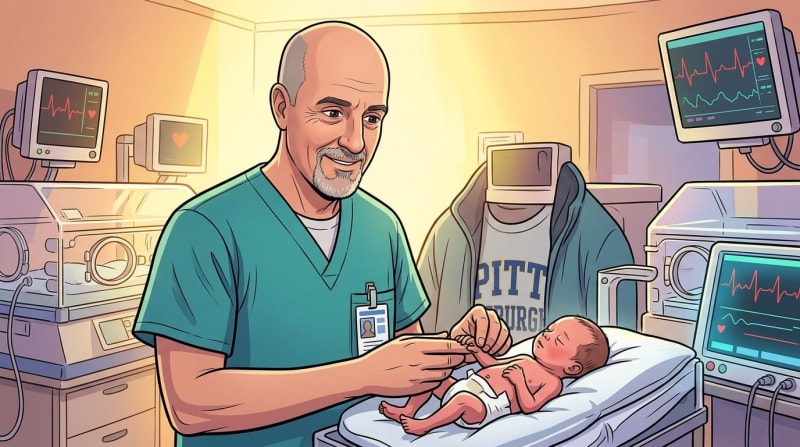
For families in a Rochester NICU today, this research does not change what is happening in the room right now. But it changes what is coming. There is something meaningful in knowing that the clinicians in that room are connected to researchers who spend their working hours building better tools for the next family who walks through those doors.
What does it mean to receive care in a city that also produces this kind of research? That question doesn't need to wait for the tool to be built. The answer is already here — in the collaboration, in the work, in a group of Rochester researchers who decided that a premature baby's lungs were worth the next several years of their careers.
Content ID: djH80Y40CTPI6mFch3p8UVI5
See an error? Tell us.


Comments
Share with the Community