Hopeman Carillon Summer Concerts at the University of Rochester
The Short Version
- Four free Hopeman Carillon concerts ring out over the University of Rochester's Eastman Quadrangle on Monday evenings at 6:30 pm — July 20, July 27, August 3, and August 10.
- The carillon is a real instrument: 50 bells weighing more than three tons, played live by hand and foot from a cabin about 186 feet up in the Rush Rhees tower, and the most actively played of the six in New York State.
- Each guest carillonneur brings a wildly different program, from Quebec folk songs and Florence Price to spectral minimalism and a carillon arrangement of "Call Me Maybe."
- Arrive after 4 pm for free parking in the library lot at 755 Library Road, bring a picnic, and stick around afterward — performers come down to greet the crowd on the quad.
- This summer's series is hosted by Gwendolyn Saarie and led by University Carillonist Carson Landry — a free tradition that asks nothing of anyone who shows up: no ticket, no dress code, just a lawn and the bells.
A Concert Hall With No Walls
A Concert Hall With No Walls
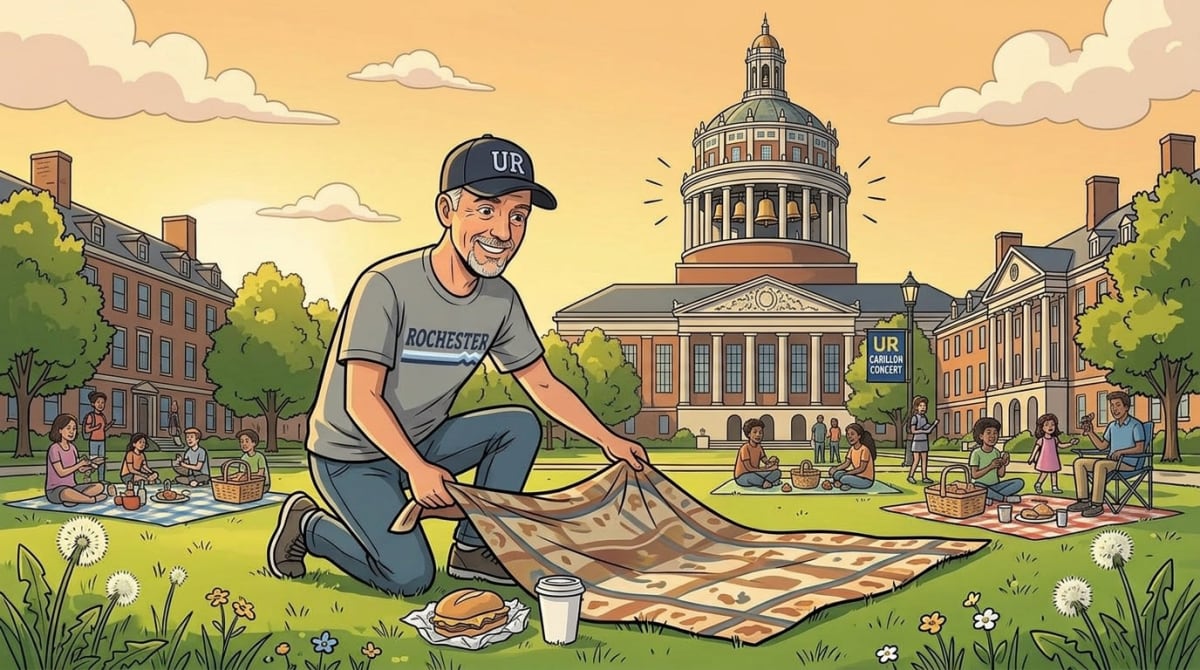
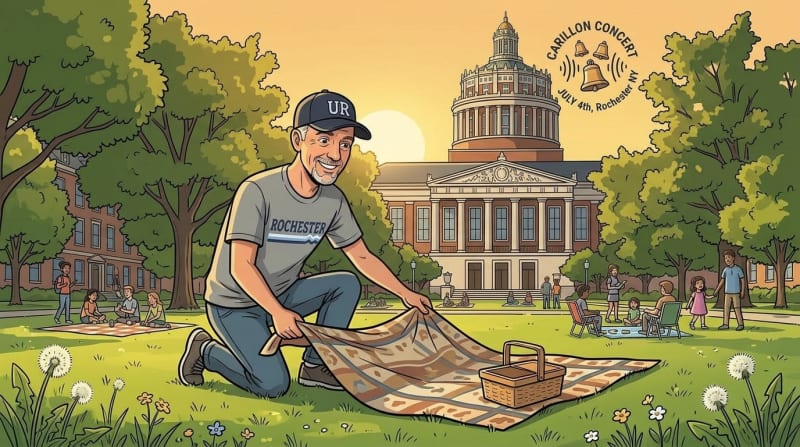
Some of my earliest memories of music came from above my head. My father came to Rochester for graduate school at the Eastman School of Music, and his love of music was the kind that rearranges a family's weekends around it. On summer evenings we would spread a blanket on the Eastman Quadrangle, unpack a picnic, and listen as the bells in the Rush Rhees Library tower rang out over the lawn. I didn't understand yet that I was hearing one of the rarest instruments in the state. I just knew the whole campus had turned into a concert hall with no walls. Those evenings have a name — the Hopeman Carillon summer concerts — and they are back again this year.
Four free outdoor performances will ring out over the University of Rochester's River Campus on Monday evenings this July and August. No tickets, no seats to reserve, no dress code. Just a lawn, the bells, and whoever decides to show up.
What a Carillon Actually Is — and Why Rochester Has One of the Best

What a Carillon Actually Is — and Why Rochester Has One of the Best
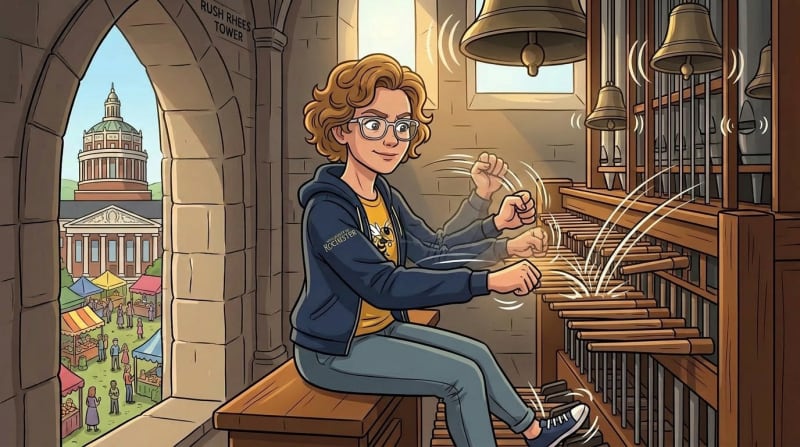
A carillon is not a recording, and it is not automated. It is a real instrument of at least 23 tuned bells, played live by a person at a console of wooden batons and foot pedals. The player works the bells with a closed fist, a baton, an open hand when needed, and the feet — and though the motion can look violent, the fist snap is closer to bouncing on a trampoline: it strikes and springs right back up. That stroke drives the clapper against the inside of the bell with such control that a single player can move from a whispering tinkle, to melodic ringing, all the way to a percussive, tuned cannon roar. The expression is unique to each musician — their interpretation, strength, and skill — and played vigorously in a summer tower with no air conditioning, it is also a real workout. The Hopeman Memorial Carillon is a set of 50 bells weighing more than three tons, played from a cabin roughly 186 feet up inside the Rush Rhees tower. Everything you hear travels from a musician's hands and feet, through bronze cast at the Royal Eijsbouts foundry in Asten, Netherlands, and down onto the quad. As Doris Aman, a longtime carillon fan, puts it:
"These bells from Asten ring music by human hands. Nothing AI here."
Bells have rung over the River Campus since it opened in 1930 — first as a 15-bell chime, expanded to 17 in 1956, and finally replaced by today's 50-bell carillon, installed in 1973.
According to the 2026 series program, Rochester's carillon is the most actively played of the six in New York State — its University Carillonist and faculty instructor, Carson Landry, plays it by hand alongside students throughout the school year, and the quarter-hour Westminster chime is one of its few automated moments. The rest is people. When was the last time you heard live music you didn't buy a ticket for, on the grass beside strangers who become, for an hour, neighbors?
Four Free Hopeman Carillon Summer Concerts in 2026
This summer's series is hosted by Gwendolyn Saarie, an Eastman Community Music School instructor and University of Rochester student carillonist, appointed to the role by Carson Landry. This year's guest carillonneurs, profiled in the 2026 series program, come from across North America, and each brings a strikingly different program. All four concerts begin at 6:30 pm.
The series opens July 20 with Andrée-Anne Doane, titular carillonist of Saint-Joseph's Oratory in Montreal, playing Quebec folk songs, French chanson like "La vie en rose," and Gershwin's "Summertime." On July 27, Sheryl Modlin — a carillonneur from Ohio who is also a pediatric anesthesiologist at the Cleveland Clinic — moves from Bach and Florence Price to the spiritual "Wade in the Water" and the Beatles' "Here Comes the Sun." August 3 brings Julie Zhu, a composer and assistant professor at the University of Michigan, who leans into spectral minimalism, jazz standards, and a pair of her own compositions written for the high bells. And on August 10, Michael Gancz, a carillonist and Ph.D. researcher at Stanford, closes with a program he calls "look up" — Oscar Peterson, Dvořák's "New World" Symphony, and a full carillon arrangement of Carly Rae Jepsen's "Call Me Maybe." Gancz writes that in a world bent on turning communities into consumers, the carillon asks us to do exactly that: stop, and look up.
Taken together, the four programs are astonishingly varied. By our count of the published programs, the music splits almost evenly across five worlds:
You can come for the Beethoven and stay for the Beyoncé. Which program calls to you?
How to Make an Evening of It
How to Make an Evening of It
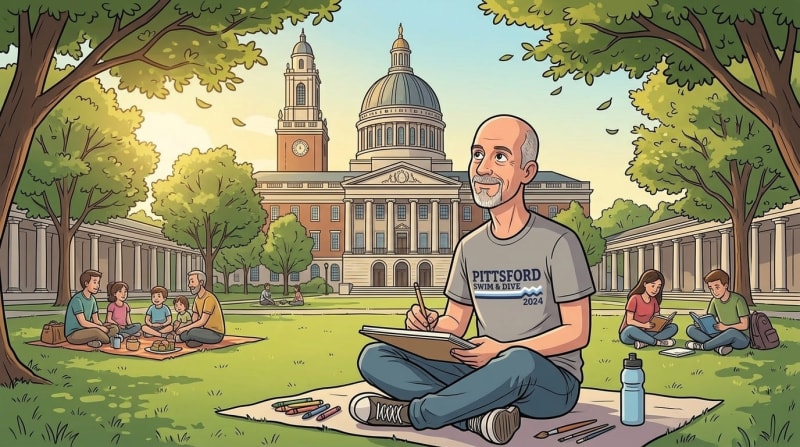
The concerts take place on the University of Rochester's Eastman Quadrangle, in front of Rush Rhees Library. Parking is free in the library lot at 755 Library Road after 4 pm, so you can arrive early and settle in with a blanket, folding chairs, and a picnic. These are the kinds of nights that lodge in people's lives. There are fireflies as the light goes, trees moving in the breeze, a sunset over the Genesee, and sometimes an artist who has come simply to sketch the moment. After the last bell, the performers climb down and greet the audience on the quad — a rare chance to talk with a working carillonneur about an instrument most of us only ever hear from below. Can't make it in person? Every concert is livestreamed on the Hopeman Carillon's channels.
A Best-Kept Secret Worth Sharing
A Best-Kept Secret Worth Sharing
For all the devotion this series inspires, it stays one of those Rochester gifts that hides in plain sight, ringing out over a campus thousands of people cross without ever looking up.
"These charming carillon concerts are Rochester summer's best kept secret."
— Doris Aman
What I love most about the carillon is how few conditions it places on belonging. There is no ticket, no dress code, no barrier to who gets to sit on the lawn — it makes room for people that more formal venues can't. "A shared moment in freeze frame," as Doris Aman describes it. That is the quiet radicalism of an instrument that asks nothing of you except that you stop and listen.

In this USA250 summer, the wish is a simple one: to hear these bells ring freely, for everyone. Bring your friends. Bring your community. Bring whoever in your life needs an evening that asks nothing of them. I learned the worth of one of these nights on a blanket beside my father, years before I had words for it — and this year, four musicians will climb 186 feet of stairs and play their hearts out over a lawn full of people they'll never meet. What would it mean to spend one summer Monday looking up?
Content ID: DBuuc4OlHFxgedgCFTTkOPNV
See an error? Tell us.


Comments
Share with the Community