
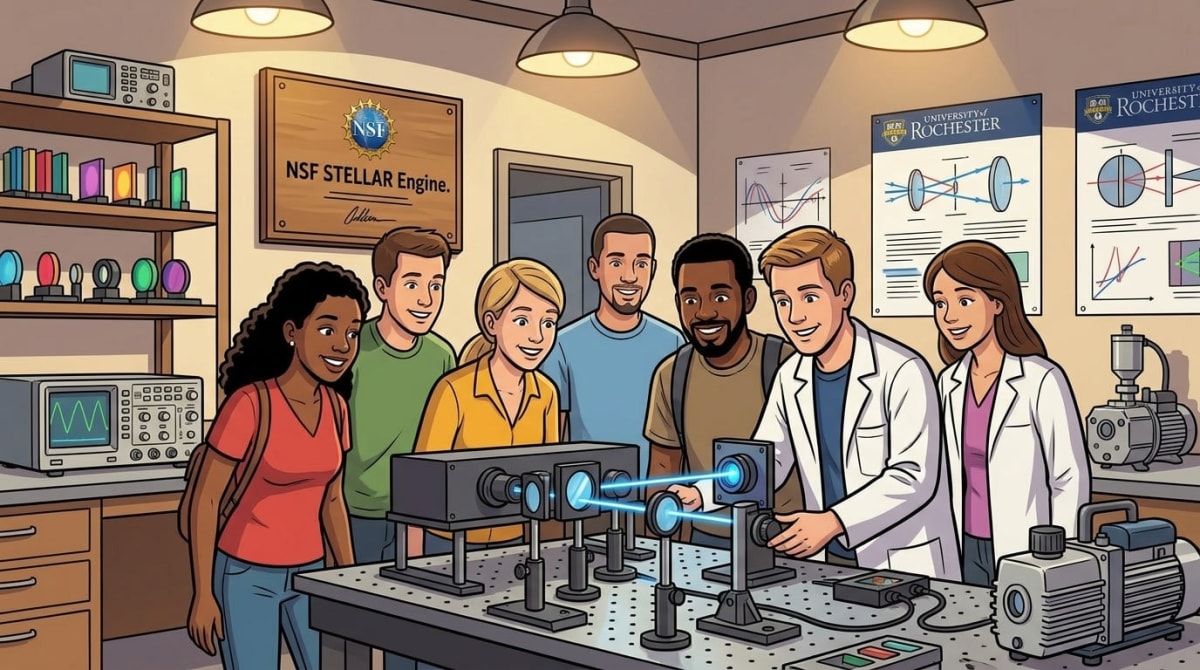
Rochester Just Became America's Laser Research Hub — What the STELLAR Engine Means for Our City
The Short Version
- Rochester secured one of just 12 NSF Regional Innovation Engines nationally, bringing $31M in committed funding — $15M federal plus $16M from New York State — with potential for $160M over the next decade.
- The University of Rochester's Institute of Optics, the nation's premier program in the field, was founded nearly 100 years ago; the Laboratory for Laser Energetics operates the world's largest academic lasers.
- Rochester already hosts more than 150 optics, photonics, and laser supply-chain companies — giving the STELLAR Engine a built foundation to accelerate, not a blank slate to start from.
- More than 90 organizations signed on as partners before the award was confirmed, spanning universities, community colleges, economic development agencies, and industry.
- Monroe Community College's anchor role is structural: creating workforce pipelines into optics careers for local students at scale, not programming add-ons.
- The initiative's explicit goal — bringing U.S. laser research and manufacturing to global competitive scale — positions Rochester at the center of a national industrial strategy.
Something in Rochester shifted last week that most of the country hasn't registered yet — but anyone who grew up here, or who came here to study or work in optics, already knows what it means.
The National Science Foundation designated Rochester as America's national hub for laser research and development. The initiative is the NSF STELLAR Engine — Science, Technology and Engineering for Laser and Laser Applications Research — led by the University of Rochester and backed by $15 million in federal funding, $16 million from New York State, and the potential to reach $160 million in investment over the coming decade.
Rochester wasn't selected on the strength of a promising proposal. It was selected because of what it already is: the most concentrated hub of optics, photonics, and laser expertise in the United States, built over nearly a century of serious institutional work. The NSF isn't starting something new here. It's recognizing something that has been true for a very long time.
What Is the NSF STELLAR Engine — and Why Did Rochester Win?

What Is the NSF STELLAR Engine — and Why Did Rochester Win?
The NSF Regional Innovation Engines program identifies regions where the conditions for transformative technology ecosystems already exist, then invests at a scale designed to generate lasting national impact. Rochester's STELLAR Engine was one of 12 teams selected nationally, representing 20 states.
The competition wasn't won on ideas alone. It was won on existing infrastructure. The region is already home to more than 150 optics, photonics, imaging, and laser supply-chain companies. That's not a target or a goal — that's what Rochester already looked like before the federal award arrived.
Here is how the committed funding breaks down at launch:
The STELLAR Engine has the potential to eventually receive up to $160 million over the next decade — contingent on regional performance targets. This is not a one-time grant. It is a decade-long investment framework tied to demonstrated outcomes: jobs created, companies expanded, students placed into careers.
Rochester's Laser Legacy: A City Built on Light

Rochester's Laser Legacy: A City Built on Light
To understand why Rochester won this, you have to understand what Rochester already is.
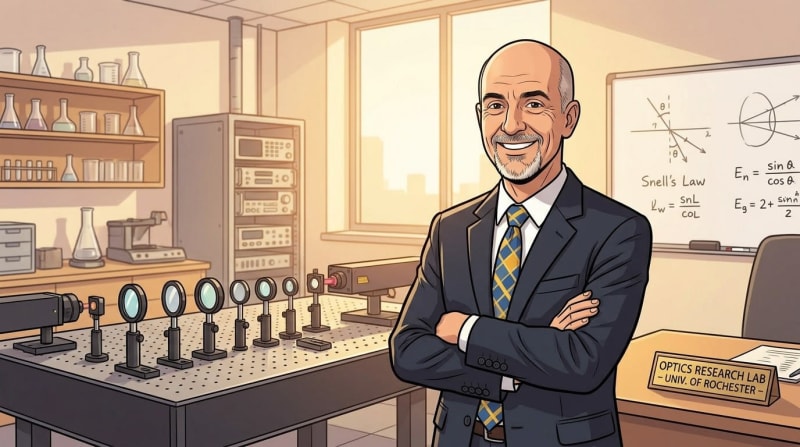
The University of Rochester's Institute of Optics is the nation's premier program for education and research in optics, photonics, imaging, and laser science — founded nearly 100 years ago. That's nearly a century of training the scientists and engineers who build the technology the world depends on. Institute of Optics director Thomas Brown said it plainly when the award was announced: "Rochester's brainpower in optics, photonics, imaging, and laser technology is unmatched."
Then there is the Laboratory for Laser Energetics — where, in the LLE's own words, "the brightest minds come to unlock new frontiers in security, energy, and discovery." The LLE operates the world's largest lasers in academia. Its OMEGA facility is not a proposal or a rendering. It is a functioning world-class laser research operation that has been running for decades, right here in Rochester.
Rochester's long history in precision optics and imaging work left something that economic downturns could not take away: a citywide fluency in working at the edge of what's optically possible. That knowledge lives in the universities. It also lives in those 150+ companies still operating here, in the engineers who stayed, in the technical culture that runs through this region like a thread.
What does it mean for a city to have 150+ specialized companies in a single technical field? It means the workforce pipeline already exists. The supplier relationships already exist. The culture of precision already exists. What does it mean that those companies are still here, still hiring, still doing the work — decades after the industrial era that first drew them? That's not momentum. That's bedrock.
What $160 Million Will Actually Build Here
What $160 Million Will Actually Build Here
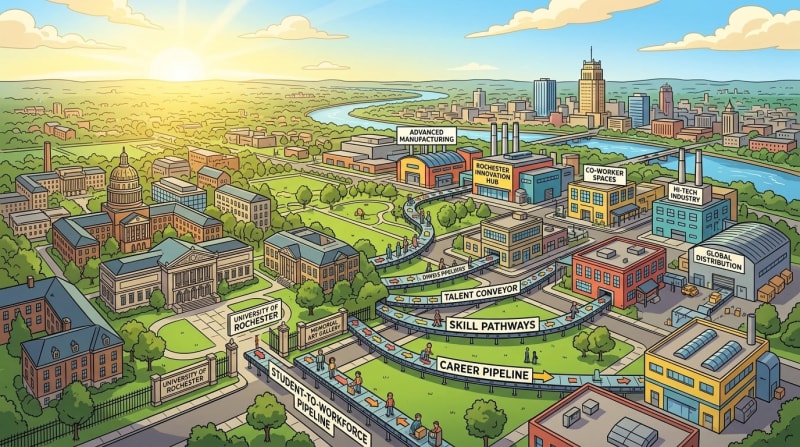
The architecture of the STELLAR Engine investment matters as much as the headline number. This is not a grant designed to live inside a university building. The stated goal is to "bring New York laser research, development, and manufacturing to a scale that can compete globally" — which means the investment targets manufacturing floors and workforce pipelines, not just research journals.
The initial committed investment covers laser technology R&D, workforce development pipelines, business expansion and attraction, and domestic manufacturing capability. The federal award is $15 million in NSF funding over two years, matched by $16 million in New York State funds.
The distance between $31 million and $160 million is where Rochester's work happens over the next decade. The performance-based structure means the region's institutions, companies, and workforce pipeline have to demonstrate real outcomes to unlock later-stage funding. That accountability is not a risk — it aligns the investment with the actual goal: a functioning, globally competitive laser technology cluster in Upstate New York.
For the region's existing optical companies, STELLAR is not an abstract federal initiative. It is a structured commitment to the supply chain and talent infrastructure they've been sustaining informally for years. It gives them a national platform — and a vehicle to grow.
The Coalition: 90+ Organizations Working Together
The Coalition: 90+ Organizations Working Together
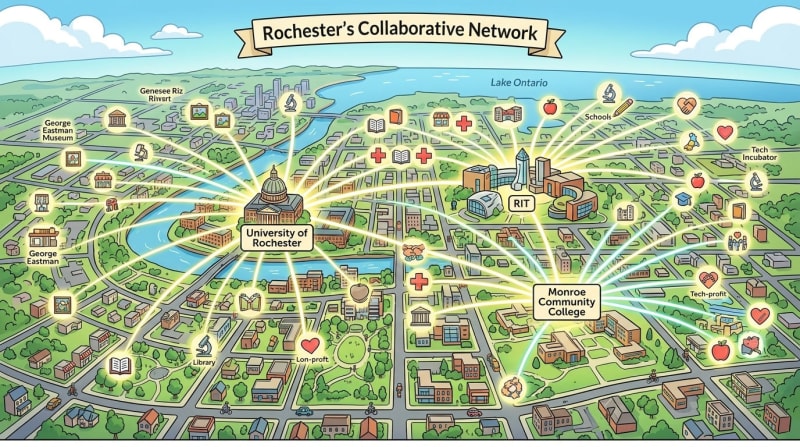
The STELLAR Engine is not a university program with some external branding applied. It is a genuine regional coalition, and the coalition's breadth is part of what made Rochester's bid competitive.
The anchor institutions are the University of Rochester, Rochester Institute of Technology, and Monroe Community College. That combination is deliberate. The University of Rochester brings fundamental and applied research at the highest level. RIT brings polytechnic orientation with strong industry connections. Monroe Community College brings what the other two can't: a direct pathway to workforce training at scale, positioned to bring students from this region into optics careers in significant numbers. MCC's role here is not decorative — it's structural.
On the economic development side, formal partners include NextCorps, Greater Rochester Enterprise, AmeriCOM, and New York State's Economic Development agency — the organizations that translate laboratory results into business formation and regional investment decisions.
In total, more than 90 organizations have offered collaboration and support, including venture capital firms, nonprofits, local government, and industry. The fact that 90+ organizations signed on before the award was even confirmed says something important about how Rochester's institutions have learned to work together over the years.
A coalition that size has practical consequences. When a problem surfaces — a workforce gap, a supplier shortfall, a company that needs lab access — there is infrastructure to address it. What becomes possible when 90+ organizations are aimed at the same goal, with a federal mandate behind them?
What It Means for Rochester — Jobs, Students, and the City's Future
What It Means for Rochester — Jobs, Students, and the City's Future
This is the part that matters most for the people who actually live here.
The STELLAR Engine's workforce development focus means structured pathways into optics careers for students who live in this region — anchored at Monroe Community College, designed to change the calculus for a student deciding whether to stay in Rochester after graduation. Not one-off internships. Career pipelines. If those pipelines work as designed, they change who Rochester keeps and who Rochester attracts.
For the region's 150+ existing optical companies, the initiative represents a supply chain and talent development investment that makes it easier to hire, easier to grow, and easier to make the case to new workers and new investors that Rochester is the right place to be.
"Rochester's brainpower in optics, photonics, imaging, and laser technology is unmatched."
— Thomas Brown, director of the University of Rochester's Institute of Optics, July 14, 2026
This city has never lacked for talent or for institutions willing to do serious work. What it has sometimes lacked is the national recognition — and the resources — to turn that work into durable economic growth at the scale the talent here deserves.
The NSF STELLAR Engine is that recognition. What Rochester does with it over the next decade is, as it always has been here, up to the people actually doing the work — and the students deciding whether to stay and become part of what comes next.
Content ID: EJk2bBHo3gLECW22CAKSvliS
See an error? Tell us.

Comments
Share with the Community