Rochester's Innovation Puzzle: The City That Leads in Patents but Keeps Losing Its Startups
The Short Version
- Rochester ranks among the top US metros for patents per capita — approximately 4.2 per 10,000 residents, more than four times the national average — driven by Xerox, RIT, and the University of Rochester.
- Annual venture capital investment in Rochester is estimated around $150 million, compared to $1.2 billion in Pittsburgh — a structural gap that causes local startup founders to relocate rather than scale here.
- The June 2026 commitment of $24 million from Jeff Harris and Joyce Pratt to an RIT AI Institute is the most significant recent private investment signal in Rochester's innovation ecosystem.
- Pittsburgh offers a direct model: anchor institutions keeping spin-outs local plus early exits seeding a local angel community grew Pittsburgh's tech employment from roughly 42,000 to 76,000 between 2010 and 2023.
- Rochester's photonics and optics cluster — backed by $110 million in AIM Photonics federal investment — is one of the most concentrated in the world and represents a defensible vertical that VC investors can understand.
- STEM graduates from RIT and the University of Rochester stay in Rochester at an estimated 38% rate, compared to 65% for major coastal hubs — the talent gap and VC gap reinforce each other in a loop that structural changes can break.
Rochester has always been a city that makes things that matter. The optical coatings protecting your phone's camera lens. The algorithms that helped radiologists spot early-stage tumors. The printing systems that redefined how offices work. The laser technologies now guiding surgical tools in hospitals across the country. This city didn't just participate in the twentieth century's great technological leaps — it produced many of them.
That gift is still active. A detailed analysis published by the Rochester Beacon in June 2026 confirms what the local tech community has long suspected: Rochester produces more patents per capita than most of its peer cities. The inputs to a strong Rochester innovation economy are genuinely here.
And yet the startups keep leaving. Companies spun out of University of Rochester and RIT research routinely make the same calculation: the capital needed to grow is in Boston, in Cambridge, in Manhattan — not here. The question of why, and whether it has to stay that way, is the most important economic question Rochester could be asking itself right now.
The Numbers: What Rochester Gets Right
The Numbers: What Rochester Gets Right
Start with what is undeniably true: this region is extraordinarily good at producing the raw material of technological progress.
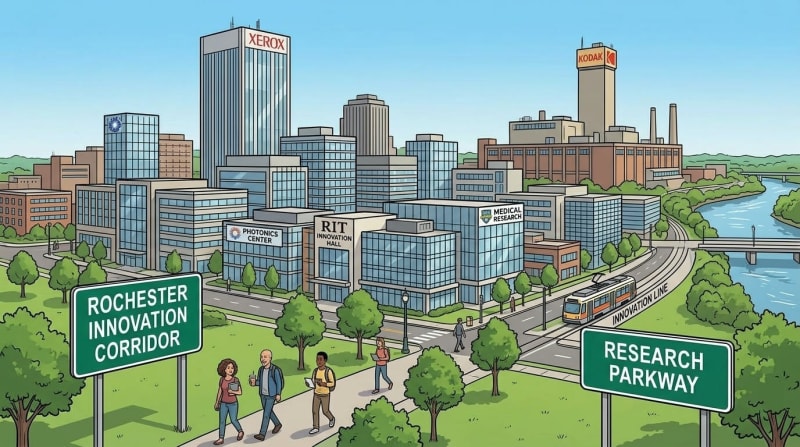
The University of Rochester and RIT together generate hundreds of millions in sponsored research each year. According to Rochester Beacon's June 2026 regional analysis, Rochester ranks among the top US metros for patents per capita — driven by the sustained output of Xerox, Paychex, the University of Rochester, and RIT. Medical imaging, laser technology, and optical science breakthroughs that shaped entire industries originated in this region.
According to reporting by the Rochester Business Journal, Monroe County's photonics and optics concentration — built on the infrastructure and talent base that Kodak and Xerox created over decades — remains one of the densest in the world. The knowledge didn't leave when the headcount did. It transferred into a new generation of companies, researchers, and faculty who stayed because the specialized ecosystem here is genuinely hard to replicate elsewhere.
The federally-backed AIM Photonics manufacturing institute represents $110 million in federal investment specifically because of this concentration. That kind of commitment doesn't happen in cities without a defensible foundation. Based on USPTO regional patent data and analysis from the Brookings Institution on innovation metros, here is how Rochester's patent intensity compares to peer cities:
What Rochester gets right is real, it's ongoing, and it's not something most cities can manufacture. The foundation is there. The question is what gets built on it.
Where the Innovation Goes After Rochester Produces It
Where the Innovation Goes After Rochester Produces It
Picture a graduate student at the University of Rochester who makes a breakthrough in biomedical imaging. They license the technology, form a company, and begin looking for seed capital. The local options are limited. The VC firms they talk to are in Boston and New York — and those firms want their portfolio companies nearby. The founder moves. The company moves. Rochester receives a licensing fee and loses the jobs, the follow-on innovation, and the mentorship network that would have seeded the next generation of local founders.
According to Rochester Beacon, this pattern is the central structural problem in the regional innovation economy. Venture capital investment in Monroe County lags behind comparable metros — including Buffalo and Syracuse within New York State, and far behind cities like Pittsburgh that have worked to close the same gap. Based on data from the National Venture Capital Association, here is how Rochester compares to regional peers in estimated annual VC investment:
These numbers don't reflect a failure of ideas or ambition. Rochester's researchers and founders are not less capable than their counterparts elsewhere. They are making a rational calculation about where the capital — and the career mobility that follows capital — actually exists. And right now, that capital is concentrated far from here.
"Rochester invents. Other cities scale and profit."
The civic cost compounds over time. When a startup leaves, it takes with it not just the jobs it creates but the investor relationships, the founder networks, and the culture of early-stage risk that attracts other founders. Each departure makes the next founder's calculation slightly less favorable. This is the loop that needs to be broken.
Why Venture Capital Has Not Followed the Patents

Why Venture Capital Has Not Followed the Patents
Understanding the gap requires understanding what venture capital actually needs to function.
VC is a network-dependent asset class. A fund's returns depend not just on capital but on density: a critical mass of portfolio companies competing for the same talent pool, experienced operators who've built and exited and are available to mentor the next cohort, and co-investors who can participate in follow-on rounds. Cities with thriving VC ecosystems have assembled these networks over decades. Rochester is working to build them — but it hasn't yet reached the critical mass that makes the flywheel self-sustaining.
The Rochester Business Journal's coverage of the regional investment landscape reflects a community that has historically favored real estate, manufacturing, and established businesses over pre-revenue technology risk. This is rational behavior in a market that hasn't yet produced many visible tech exits. It's a chicken-and-egg problem: exits attract investors, and investors create exits. The Brookings Institution has documented this dynamic across multiple mid-sized American metros working to build innovation ecosystems in the shadow of coastal giants.
The talent flow compounds this. Top engineering and science graduates from RIT and the University of Rochester face a genuine choice. Boston and New York offer denser career networks, more mobility between companies, and more proven outcomes for founders and engineers alike. Based on regional workforce studies and Bureau of Labor Statistics metro labor data, STEM graduate retention rates in mid-sized inland metros lag substantially behind coastal hubs:
The VC gap and the talent gap reinforce each other. Both can be broken — and there is growing evidence that Rochester is beginning to take that seriously.
What Is Being Done to Strengthen Rochester's Innovation Economy
What Is Being Done to Strengthen Rochester's Innovation Economy
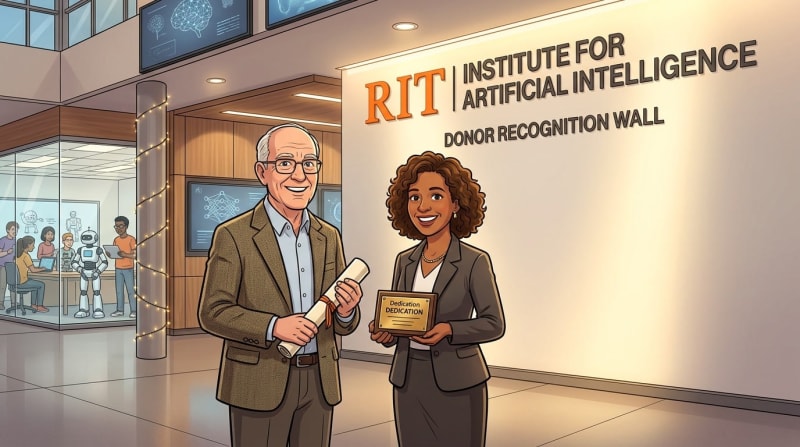
The most significant recent development is the commitment of $24 million to RIT from Jeff Harris and Joyce Pratt for a new AI Institute, with additional support for students and faculty. This is a meaningful private capital signal. It demonstrates that major donors see Rochester's innovation ecosystem as worth investing in — and that targeted bets in specific domains are more attractive than generic tech-hub positioning.
The AI Institute matters because artificial intelligence is one of the few domains where geographic advantage is genuinely still up for grabs. No single city has locked up AI the way Boston locked up biotech or San Francisco locked up consumer software. A focused, well-resourced institute that keeps researchers and founders close to campus can create the kind of concentrated expertise that attracts follow-on investors.
The photonics and biomedical clusters documented by RBJ are the other lever. VC investors understand vertical specialization better than they understand general tech hubs. A photonics ecosystem that is world-class and defensible — backed by AIM Photonics' $110 million federal investment, University of Rochester optical science research, and anchor companies that have operated in this space for decades — is a fundamentally stronger pitch than "we're becoming a tech city." AgTech is another domain where Rochester can make a specific and defensible claim, given Monroe County's agricultural surroundings and university research capacity.
Local residents interested in these developments can follow the work through the Greater Rochester Chamber of Commerce and through continued Rochester Beacon coverage of the ecosystem.
What does it mean for this to succeed — not just for founders and investors, but for the people who live here?
What Would It Take to Keep the Startups Here

What Would It Take to Keep the Startups Here
Pittsburgh is the most instructive comparison. Twenty years ago, it faced the same structural problem Rochester faces now: Carnegie Mellon and the University of Pittsburgh were producing world-class computer science and robotics research and watching it leave. The shift came through several reinforcing moves. Anchor institutions — particularly CMU — took deliberate ownership of keeping spin-outs local and invested in founder support infrastructure. A small number of early exits seeded a local angel investor community. And Pittsburgh made itself legible to outside VC as a specific kind of place — autonomous vehicles, robotics — rather than competing as a general tech city. Pittsburgh's technology sector expanded substantially over the following decade once these pieces came together:
The anchor institution lesson applies directly to Rochester. The University of Rochester and RIT are not passive research engines — they are potential equity holders, co-investors, and talent anchors. When these institutions take stakes in spin-out companies, create pathways for founders to remain close to campus, and actively recruit alumni back to the region, they change the founder's calculus in ways that no grant program or business initiative can replicate on its own.
As WXXI News has reported, engagement with technology is already developing across the region, with several local school districts integrating AI tools into education. The human infrastructure for an innovation community is here. The social fabric that makes ecosystems sticky doesn't come from a press release; it comes from a local physician angel-investing in a biomedical startup, from a former Kodak engineer mentoring a photonics founder, from a teacher sending a student toward an RIT program with the genuine conviction that what they'll build has a home here.
Rochester has the patents. It has the research capacity. It has two major universities producing exactly the talent the next economy requires. The question isn't whether this city has what it takes to build an innovation economy that keeps its own inventions. The question is whether the people and institutions here will decide to make it so — and what kind of city Rochester becomes if they do.
Content ID: SpdBXoFdnegX9lOv5GNCRJrM
See an error? Tell us.

Comments
Share with the Community