
The Cones Came First: How Reconnect Rochester Turned Tactical Urbanism Into Neighborhood Power
The Short Version
- Reconnect Rochester's Complete Streets Makeover program started as a coffee-shop conversation between two staffers and is now six projects deep, with a new installation at Genesee Park Boulevard on May 16.
- The sixth round of nominations alone generated 48 trouble spots identified by the people who actually walk and bike those streets — the most detailed community-driven street safety inventory Monroe County has.
- The method is tactical urbanism: cheap, removable materials like rubber curbing, cones, and paint go down first, real speed data gets collected, and only then does permanent concrete follow.
- The 2024 Avenue D & Hollenbeck project cut westbound vehicle speeds by 16%; the 2022 Orange & Orchard project dropped 85th-percentile speeds by 28% — results that now feed directly into future street reconstruction plans.
- Reconnect Rochester's real contribution isn't design or construction — it's project management and advocacy across the years it takes for a temporary installation to become permanent infrastructure.
Two women from Reconnect Rochester sat in a coffee shop a few years ago doing their standing weekly meeting. The President of the Board and the Executive Director were running through a list of things the organization could do in an ideal world — the kind of list most organizations talk themselves out of before the coffee gets cold. They landed on one idea they couldn't let go of: what if the people who actually walked, biked, and drove the dangerous intersections in Monroe County got to decide which ones deserved to change?
That conversation became the Complete Streets Makeover Rochester program, the initiative that is now quietly rewriting how neighborhoods in Rochester get safer. Six projects in, with the sixth installation happening May 16 at Genesee Park Boulevard and Pioneer Street, it's worth pausing on what makes this program work — and why the method matters as much as the results.
Starting With What the Community Already Knows

Starting With What the Community Already Knows
The first decision about the program was to put neighborhoods first. No one understands what it's like to use our streets better than the people who walk, bike and roll along them every day. So Reconnect opened a public call for nominations. Then another. And another. Over six cycles, hundreds of nominations have come in from across Monroe County — every cycle has produced dozens of candidate intersections, and the sixth round alone generated 48 trouble spots from community members. The nominations themselves provide one of the most comprehensive street-level safety inventories the county has ever had, and it came from the people who walk, bike, roll and live along those streets.
"No one understands what it's like to use our streets better than the people who walk, bike and roll along them every day."
— Reconnect Rochester
Community Collaboration

Community Collaboration
The second decision was to make this a collaborative effort. Reconnect Rochester partnered with community partners like the Healthi Kids Coalition at Common Ground Health, which provided its traffic calming library — a shared inventory of rubber curbing, portable bump-outs, flexible bollards, and pedestrian delineators. It meant the early Makeovers cost the neighborhoods almost nothing in materials. You can screw rubber curbing into asphalt, shape a chicane, build a traffic circle, and pull it all out again in a weekend.
The Community Design Center of Rochester ran the early community workshops to hear from neighbors and other stakeholders about their experiences and ideas. Those workshops allowed designers, traffic engineers, safe streets advocates, local business owners and neighbors to listen to each other and work together. The Genesee Transportation Council collected speed data before and after the on-street installation to demonstrate the effectiveness of the new temporary design and provide the neighborhood with data to advocate for permanent design changes.
Partner all that with Stantec, the engineering and design firm that has done the traffic analysis and renderings pro bono for multiple Makeover cycles, and you have something unusual in civic work: a full-stack program — community nominations, engineering expertise, physical materials, installation help, and long-term advocacy support — built almost entirely on borrowed resources and volunteer labor.
Tactical Urbanism, Explained Without the Jargon
Tactical Urbanism, Explained Without the Jargon
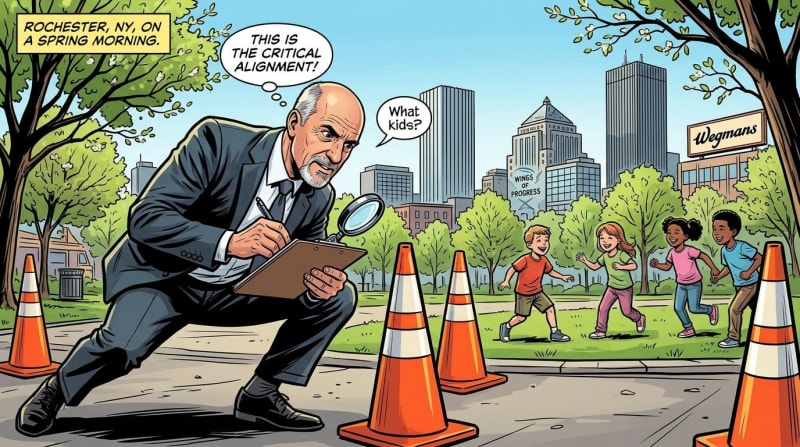
The method Reconnect Rochester uses has a name: tactical urbanism. It gets written up in planning journals and presented at conferences, but the idea is plain. Instead of spending millions of dollars redesigning an intersection based on engineering predictions, you put temporary, cheap, removable stuff on the street first — cones, rubber curbing, planters, paint — and collect real data on what happens. Does traffic slow down? Do pedestrians feel safer? Do businesses suffer? Do drivers adapt?
The most famous example is Times Square. Under then-NYC Transportation Commissioner Janette Sadik-Khan, New York closed Broadway to cars in 2009 using what amounted to paint, planters, and folding beach chairs. The city collected data. Foot traffic went up. Retail sales went up. Pedestrian injuries went down. What started as a pilot is now permanent — and the method has traveled from Boston to Buenos Aires.
People sometimes assume this approach belongs to dense, well-funded cities — that it requires the scale of Manhattan and the budget of NYC DOT to pull off. It doesn't. Macon, Georgia saw bike traffic increase 800% after a temporary bike lane pilot, which became permanent. Everett, Massachusetts used orange cones to create a temporary bus lane that actually decreased travel time for both buses and cars.
And in Pittsford Village, a few years ago, the DPW temporarily put out orange cones to test how a bump-out might affect driver speeds on a section of State Street. NYSDOT eventually asked that the cones be removed, but not before the Village collected some valuable data about what kind of permanent change State Street can absorb.
Cones first. Concrete later. Sometimes a stop-work order in between.
What Reconnect Rochester Actually Does

What Reconnect Rochester Actually Does
Here is what took me a while to understand about Reconnect Rochester, and what I think makes them unusual in this space: they are not really the designers. They are not really the builders. They are not really the government.
They are the project manager.
Read that again. The value Reconnect provides is that nothing gets lost between a neighborhood's frustration and a municipality's paving schedule. When a Makeover installation goes in, someone has to remember to remove it before winter so the plows don't destroy the rubber curbing. Someone has to remind the neighborhood to pull the permits to repaint the mural when it fades. Someone has to show up at the public meeting five years later when the road is scheduled for resurfacing and advocate for the temporary changes to go permanent. Someone has to hand the neighborhood the toolkit and then keep checking in.
That someone is Reconnect Rochester.
Why This Loop Works in a Rust Belt City

Why This Loop Works in a Rust Belt City
Rochester is not Manhattan. It doesn't have Manhattan's density, budget, political capital, or foot traffic. What it does have is hundreds of neighborhood intersections where everyone who uses them knows they're dangerous, and a local nonprofit that has figured out the sequence that turns that knowledge into actual concrete.
That knowledge matters more every year. Rochester recorded a record-high 15 pedestrian and cyclist deaths in 2023, an average of 12 people die each year in Monroe County while walking or biking, and the county led the region with nearly 300 pedestrian-involved crashes in 2023 alone. These are not abstract numbers. They are why the speed data from a temporary rubber-curb installation matters.
Here is the equation almost nobody talks about when arguing about traffic calming: pedestrian fatality risk doesn't climb linearly with vehicle speed. It climbs steeply. According to the AAA Foundation for Traffic Safety, the average risk of death for a pedestrian struck by a car reaches 10% at 23 mph, 25% at 32 mph, and 50% at 42 mph.
That shape of curve is why a 16% speed reduction is not a cosmetic win. It moves intersections from one zone of the curve to another. It is the difference between a crash someone walks away from and a crash someone doesn't survive.
The Avenue D and Hollenbeck Street project in 2024 reported a 16% reduction in westbound vehicle speeds after the temporary installation went in, alongside resident-reported improvements in perceived safety. The butterfly mural painted on the street — chosen by the El Camino neighborhood itself — now doubles as a visual cue that drivers are entering shared space. That's not decoration. That's infrastructure.
And the 2018 project at Parsells Avenue and Greeley Street, the very first one, eventually led the City of Rochester to install two permanent raised crosswalks along Parsells — proof that the temporary-to-permanent loop actually closes, even when it takes two years.
Watch the Neighborhoods Do This
Watch the Neighborhoods Do This
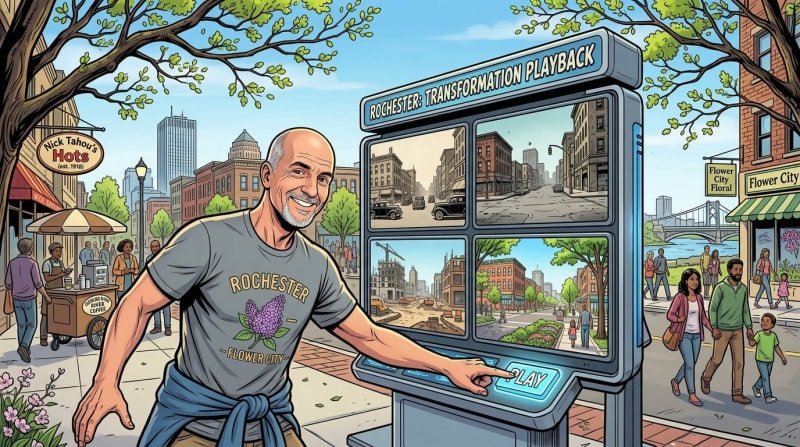
One thing that stays with me about this program is how much of it survives on film. Floating Home Films has been documenting the Makeovers from the beginning, and Reconnect has posted every film alongside the full project writeup for each intersection. Watching these back-to-back is the clearest way to understand the method — because you see the same sequence unfold in four different neighborhoods, each one specific to its place.
- Parsells & Greeley (2018, Beechwood) — the first one. A young child was killed on this stretch in 2016, and the neighborhood rallied to take back a car-dominated speedway.
- Orange & Orchard (2022, JOSANA) — after installation, the 85th-percentile speed dropped 28%.
- Arnett & Warwick (2023, 19th Ward) — included a parklet in front of the Arnett Branch Library with turf, hopscotch, and a copycat Simon Says game. The City has already approved a permanent crosswalk here.
- Avenue D & Hollenbeck (2024, El Camino) — the butterfly mural and the 16% reduction in westbound speeds.
Put them on in the background while you do something else. By the third one you start to recognize the pattern — and that's the point.
The Gift That Usually Goes Unnamed

The Gift That Usually Goes Unnamed
In most community work, what gets celebrated is the visible stuff — the ribbon cutting, the mural, the before-and-after photo. What rarely gets named is the connective tissue: the organization that held the relationships together across three different mayors, four different neighborhood association presidents, and a county DOT reshuffling. The group that remembered which permit needed renewing. The voice that spoke up at the resurfacing hearing. The steady presence that showed up at the community workshop, and then the follow-up workshop, and then the one after that.
What if the most valuable thing a small nonprofit can do isn't to have the answer, but to hold the space where a neighborhood's answer can be heard, tested, and eventually poured in concrete?
Seeing It in Person

Seeing It in Person
On Saturday, May 16, the sixth Complete Streets Makeover installation goes in at Genesee Park Boulevard and Pioneer Street in the 19th Ward. Volunteers will paint a street mural. Rubber curbing will go down. Speed data will be collected before and after. The city has a reconstruction of Genesee Park Boulevard scheduled for 2032 — meaning the data collected from this temporary installation will shape what the permanent street actually looks like six years from now.
If you live in the 19th Ward, go. If you don't, go anyway. Watch what happens when a neighborhood paints its own street. Notice how many volunteers show up. Notice how it changes the way the intersection feels to walk through.
What could your intersection look like if you nominated it next cycle?
Content ID: PWlZzvDjKAp3g3jLzJYwPJch
See an error? Tell us.
Comments
Share with the Community