

RIT Just Launched an AI Degree. Here Is Why That Matters for Rochester.
The Short Version
- RIT's new BS in artificial intelligence launches fall 2026 — a four-year program with mandatory co-ops, specializations in agentic AI and robotics, and a first-year ethics course built into the core curriculum.
- Two required co-op semesters mean every AI graduate will have spent roughly a year working inside real organizations before graduating, feeding directly into Rochester employers already struggling to find AI talent.
- Rochester's AI moment is not a pivot — it is a translation of the city's optics, photonics, and imaging heritage into the technical language that AI systems actually run on.
- AI job postings in the U.S. grew from 20,600 in 2010 to more than 1 million by 2025, and Rochester employers across healthcare, defense, financial services, and cloud computing are actively hiring now.
- RIT has ranked No. 54 in computer science nationally, has offered an AI master's since 2023, and created the nation's first undergraduate programs in IT and software engineering — this degree is the next step in a four-decade arc.
- Rochester's NextCorps is explicitly trying to end the city's status as a best-kept secret — the RIT AI pipeline is part of the infrastructure that makes that ambition real rather than rhetorical.
RIT Has Been Teaching AI Since 1986. This Fall Is Different.

RIT Has Been Teaching AI Since 1986. This Fall Is Different.
Rochester has a habit of building things before anyone is watching. The first undergraduate program in information technology in the country — RIT, 1986. The first undergraduate software engineering degree — RIT, same era. The first courses in artificial intelligence at the undergraduate level — also RIT, also 1986, when most of the country had never heard the term used outside academic journals.
This fall, Rochester Institute of Technology is offering a new bachelor's degree in artificial intelligence. The interdisciplinary undergraduate program blends core programming and algorithmic principles with the chance for specialized study in areas like agentic AI and robotics. Students work on hands-on projects building and applying AI with real impact. The program begins in fall 2026.
That announcement is easy to read as routine — one more university adding one more degree in a field everyone is talking about. It is not. What RIT is launching is a structured, four-year undergraduate pipeline with a mandatory co-op requirement, built specifically around what Rochester employers need from AI professionals right now. The degree is a workforce story as much as an education story. And for a city that has been quietly repositioning itself for decades, it is one more piece of something bigger.
What the RIT AI Degree Actually Covers
What the RIT AI Degree Actually Covers
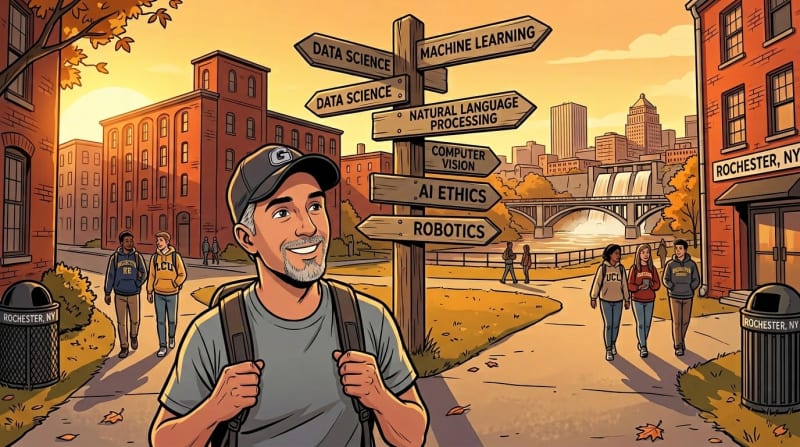
The BS in AI is not a rebranded computer science degree. According to RIT's announcement, core courses focus on optimization algorithms, security of AI, large language models, reinforcement learning, and machine learning. Students select elective courses that tailor their experience to specific domains — some will specialize in computer vision and robotic systems, others in natural language processing, and others in AI law and policy, a recognition that the people building these systems also need to understand their consequences.
The first year includes a course called AI Explorations, covering the history, ethics, data, and key algorithms of the field. The goal, according to WROC coverage of the announcement, is for future AI professionals to recognize and consider the ethical and economic impact of AI solutions in global, environmental, and societal contexts.
Starting in the same semester, RIT is also launching a six-course AI minor open to students in any major — an acknowledgment that AI fluency is becoming a cross-disciplinary requirement, not just a specialist credential.
As Matt Huenerfauth, dean of RIT's Golisano College of Computing and Information Sciences, said in the official announcement: "We're excited to continue that legacy of curriculum innovation with our BS in AI, which will prepare students to innovate with the latest AI technologies and create the next generation of AI systems. Our AI degree is informed by industry needs."
That last phrase — informed by industry needs — is the one worth holding onto.
The Co-op Is the Point

The Co-op Is the Point
RIT's co-op program is one of the most consequential features of any degree it offers, and the AI program is no exception. According to GovTech's coverage, students are required to complete two blocks of cooperative education — full-time, paid work experience — before graduating. RIT partners with companies including Google, Apple, IBM, and Microsoft for student employment opportunities.
Two mandatory co-ops means that before any BS in AI student graduates, they will have spent roughly a year working inside real organizations, applying AI in live environments, building professional relationships, and being evaluated by employers who are trying to solve actual problems.
For Rochester, this matters in a specific way. The co-op pipeline is not just national. RIT's computing graduates consistently land at local employers — Paychex, Xerox, L3Harris, Bausch + Lomb, the University of Rochester Medical Center, and the growing cluster of AI-adjacent companies that have been building quietly in the region. Every AI co-op student placed locally is a student who learns the Rochester market, builds contacts here, and faces a real decision at graduation about whether to stay.
"Students will be engaging with AI the first day that they step on campus, as part of this program."
— Sharon Mason, director of RIT's School of Information, via Spectrum News
Rochester's AI Moment

Rochester's AI Moment
The RIT announcement lands against a specific backdrop. A February 2026 analysis of Rochester's tech economy described the city as rapidly establishing itself as a hub for technological innovation while facing a widening skills gap — companies flocking to the city but increasingly struggling to find the skilled workforce to fuel their expansion.
That skills gap is real and specific to AI. Rochester Business Journal coverage of local tech leaders in early 2026 described AI as moving from experimentation to real-world, scalable applications, with companies across payroll, defense, cybersecurity, healthcare, and marketing actively deploying AI tools and looking for people who can build and maintain them. Paychex has identified AI integration as a primary strategic focus. L3Harris is applying AI to defense communications systems built here. URMC is investing in AI-assisted diagnostics. These are not future bets — they are current hiring needs.
Rochester's history makes this moment legible. The city that built Kodak's global imaging empire developed deep institutional expertise in optics, sensing, and visual data — exactly the substrate that computer vision and imaging AI run on. According to National Today's March 2026 report on Rochester's tech emergence, Rochester's history as a hub for optics, photonics, and semiconductor manufacturing has positioned it well to capitalize on the rise of AI, with the region's industrial base and growing entrepreneurial network creating conditions for a startup ecosystem rooted in science and speed.
The reinvention is not a pivot away from what Rochester is. It is a translation of what Rochester already knows into the language the next economy is speaking.
What This Signals

What This Signals
RIT's AI degree is one data point in a pattern that has been assembling for years. The university ranked No. 54 in computer science in U.S. News's 2026 rankings. Its master's degree in AI launched in 2023. Its co-op program consistently ranks among the best in the country. The new BS in AI is not a reaction to a trend — it is the next step in an institution that has been building toward this for four decades.
For a city that spent years explaining its post-Kodak identity, the accumulation of these signals starts to add up to something. Not a claim that Rochester is Silicon Valley, or that it wants to be. But a city with a specific technical inheritance, two research universities, a lower cost of living than any comparable tech market, and now a structured undergraduate pipeline specifically designed to produce the AI professionals that local employers are already trying to hire.
Rochester's NextCorps — which runs the Luminate accelerator, the world's largest for optics and photonics startups — has made the ambition explicit. As reported by the Rochester Business Journal, the organization's leadership said: "One thing we really want to focus on this year is getting Rochester recognized as one of the best places to start and scale a company. We no longer want to be the best-kept secret in the world."
The BS in AI, the co-ops it will generate, and the graduates it will send into the local economy are part of what makes that ambition something more than a tagline. Not as a branding exercise. As the actual infrastructure of a city that keeps building things before anyone is watching — and keeps finding that it was building the right things.
What would it mean for Rochester to stop being a secret? And what gifts has this city already built that the rest of the country is only now beginning to need?
Content ID: 3fzCz1jkcjInRciy50uyhQrF
See an error? Tell us.
Comments
Share with the Community