
Rochester Broadcast: A Spatial Symphony for Hundreds of Musicians Is Coming to Parcel 5
The Short Version
- Hundreds of musicians will perform a spatial symphony on Parcel 5 — the gravel lot where Midtown Plaza, the nation's first indoor urban mall, once stood.
- Rochester Broadcast fills all of downtown with sound from every direction, with players positioned across the entire block at Parcel 5.
- Midtown Plaza opened in 1962, closed in 2008, and was demolished in 2010 — leaving a gravel lot that has been waiting for something like this ever since.
- The event is a reminder that Rochester tends to figure out what to do with a space by simply deciding to use it.
- If you grew up in Rochester, this one will hit different — the block has been waiting fifteen years for a moment worth gathering for.
The Block I Remember

The Block I Remember
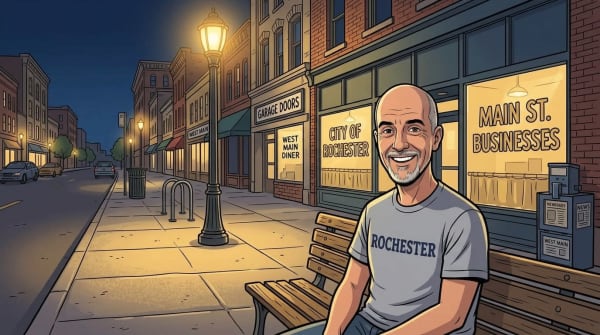
I grew up riding the number one Park Ave bus from the ABC streets down to Midtown Plaza. I was 8 or 9 years old. The fare was a dime. My buddy and I would run around that mall for hours — visiting shops, tossing coins in the fountain, watching the Clock of Nations chime. This was Saturday. This was what downtown Rochester meant to a kid from the east side.
Just down the street from Midtown, on the Sibley's side of Main Street, was Scranton's bookstore. The main floor was worth a look, but the real destination was the basement — a full HO scale model train layout running continuously, surrounded by every piece a model enthusiast could want. I was delivering papers up and down Harvard Street at the time, saving up for pieces to add to my own setup at home. I could stand down there for an hour watching those trains run. A dime got you downtown. The rest of the day took care of itself.
Midtown Plaza opened in 1962 as the nation's first indoor urban mall — designed by Victor Gruen, who conceived it not just as a retail center but as a town square, a place for people to gather in the heart of a city. It worked, for a while. Then the suburban malls arrived, the anchors closed, and by 2008 the building was shuttered. Demolition began in 2010. What was left was a gravel lot in the middle of downtown Rochester — eventually greened into a lawn, renamed Parcel 5, and waiting for the city to figure out what it was for.
Next Saturday, April 18, hundreds of musicians will fill that same block with a spatial symphony. I don't think that's a coincidence. I think that's Rochester doing what it does when it finally stops arguing about what something should be and just decides to use it.
What Rochester Broadcast Actually Is

What Rochester Broadcast Actually Is
On Saturday, April 18 — with a rain date of April 19 — Lisa Bielawa will present Rochester Broadcast at Parcel 5 on East Main Street, with performances at 12:00–12:30 PM and 2:00–2:30 PM. Free admission. Open to the public.
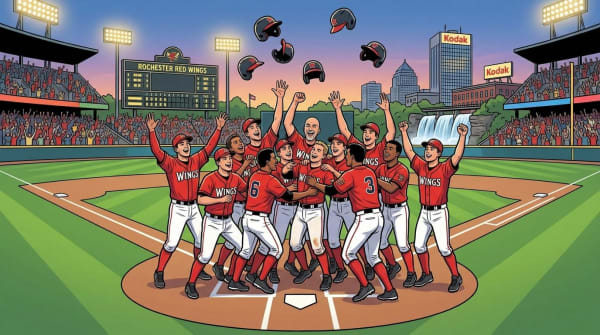
Bielawa is a Guggenheim Fellow and Rome Prize winner currently serving as Eastman School of Music's Howard Hanson Visiting Professor. Her Broadcast works are large-scale, site-specific spatial symphonies — compositions designed not for concert halls but for public urban spaces, performed by hundreds of musicians who begin playing together and then gradually "broadcast" outward in all directions, breaking into smaller groups that move through the space and among the audience.
According to the Eastman School of Music, the Rochester event brings together Eastman students, faculty, and members of the local Rochester musical community — professionals, students, and amateurs — in a single composition written specifically for this city. The word "broadcast" in Bielawa's usage is pre-radio: casting off, settling in all directions. Sound filling space the way light does.
How It Works

How It Works
The musicians don't all stand in one place and play. That's the point. The composition is meticulously planned — color-coded movement charts, rehearsals, a walk-through of the space — but what the audience experiences is something that feels organic and almost wandering: small groups drifting through the crowd, sound coming from different directions and distances simultaneously, the experience shifting depending on where you're standing.
As Bielawa told the Rochester Beacon, the words sung by the chorus were created by the participants themselves, drawn from answers to questions like "What question would you ask the Genesee River?" and "What's your earliest memory of your neighborhood?" The text includes references to snow days, canals, and local landmarks. This is not a generic composition dropped into a Rochester-shaped hole. It was written from the inside out.
Rochester joins a distinguished list of Broadcast cities that includes Berlin, San Francisco, Louisville, and Knoxville. The Berlin performance — Tempelhof Broadcast — took place on the tarmac of the former Tempelhof Airport. The San Francisco performance was at Crissy Field, involving more than 800 musicians. Each city brings its own spaces, its own musical communities, and its own history to what becomes a genuinely site-specific work.
Why Parcel 5 Is the Right Place

Why Parcel 5 Is the Right Place
Bielawa toured Rochester looking for the right venue before settling on Parcel 5. She described it as "acoustically protective" because of the surrounding downtown buildings — smaller than spaces she has used before, but right for the sound she's composing.
What she may not have known, or may have understood intuitively, is that Parcel 5 has been waiting for exactly this kind of use. The performing arts center that was planned for the site never happened. The casino proposal didn't happen. The mixed-use towers didn't happen. What happened instead, slowly and almost accidentally, was that the city started programming the space — the Rochester Fringe Festival, the Jazz Festival, outdoor concerts — and Rochesterians started showing up. The lawn got installed. The space became real.
A spatial symphony for hundreds of musicians is not a placeholder. It's a statement about what public space is for. Parcel 5 was designed to be a place where people gather. It just took sixty years and a demolition to find its way back to that.
What Rochester Can Pull Off

What Rochester Can Pull Off
There's a version of this story that's about a famous composer visiting a mid-sized city to do something ambitious. That's not the interesting version.
The interesting version is about what happens when Eastman — one of the world's great music schools, sitting in the middle of a city that has been arguing about its identity for decades — decides to use its gifts for the city rather than just within its own walls. When professional musicians, students, and community members rehearse together for months, writing text from their own memories of Rochester, to fill a block that used to be a mall with sound.

The question Bielawa asks of every city she works in is roughly: what are your musical communities, and what happens when they all play at the same time? Rochester's answer, apparently, is that you get a spatial symphony on a Saturday afternoon in April, free and open to everyone, on the same block where a kid once rode a dime bus to throw coins in a fountain.
Come find out what it sounds like.
Rochester Broadcast by Lisa Bielawa Saturday, April 18, 2026 | 12:00–12:30 PM and 2:00–2:30 PM Parcel 5, 285 East Main Street, Rochester NY | Free admission Rain date: Sunday, April 19
Content ID: 4cGCAP8drjEGqzuKdXkBLCs1
See an error? Tell us.

Comments
Share with the Community