
Rochester Vision Zero Phase 2: The City Is Coming for Speeding — and Asking for Your Help First
The Short Version
- Rochester recorded 9.66 fatal crashes per 100,000 residents over 2020-2024 — the highest rate of any mid-sized New York city, 45% above Buffalo, 43% above Syracuse, and 3x Yonkers
- The ROC Vision Zero Task Force secured $33.4M in grant funding in Phase 1, deployed 800+ school bus stop-arm cameras, and delivered pedestrian improvements in all four city quadrants
- Phase 2 focuses on speeding: the city will pursue a 25 mph citywide speed limit, launch a public traffic safety data dashboard, expand bike and curb lanes, and explore speed and red light cameras
- Two public forums this week — April 28 at Willie Lightfoot R-Center (271 Flint St., 6 p.m.) and April 29 at Carter Street R-Center (500 Carter St., 5:30 p.m.) — invite community input on automated enforcement before any cameras are deployed
- Council member Mitch Gruber directly addresses equity concerns rooted in Rochester's 2010 red light camera program, committing that any automated enforcement will be designed with thoughtfulness to fairness
- Warning period for school bus stop-arm cameras is over — fines now begin at $250 for a first offense and $300 for subsequent violations
Rochester has a traffic safety problem that is not a matter of opinion. The city recorded 9.66 fatal crashes per 100,000 residents over the 2020-2024 period — the highest rate of any mid-sized city in New York State. That rate is 45% higher than Buffalo, 43% higher than Syracuse, and three times that of Yonkers. Adjusted for severity and population, Rochester has outpaced comparable upstate cities going back nearly a quarter century.
The ROC Vision Zero initiative exists to change that. And right now, as it moves into its next phase — one focused specifically on speeding and automated enforcement — the city is doing something that doesn't always happen in municipal policy: it's asking people what they think before it acts.
Two public forums are scheduled this week. Tuesday, April 28 at 6 p.m. at the Willie W. Lightfoot R-Center (271 Flint St.) and Wednesday, April 29 at 5:30 p.m. at the Carter Street R-Center (500 Carter St.). If you live in Rochester and drive, walk, bike, or take the bus on its streets, these meetings are worth your time.
What Rochester Vision Zero Has Already Done

What Rochester Vision Zero Has Already Done
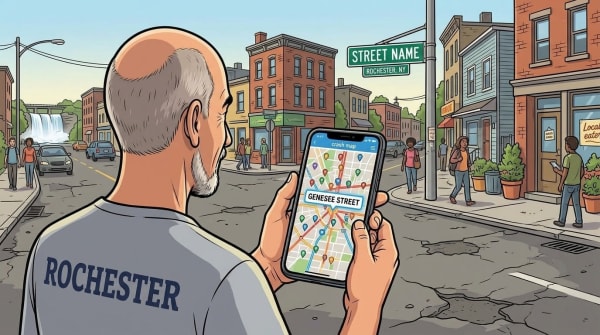
The ROC Vision Zero Task Force released its inaugural progress report in January 2026, and the numbers show real work. The Task Force secured $33.4 million in grant funding and delivered physical improvements in all four quadrants of the city — new sidewalks, improved pedestrian crossings on Genesee Street and Exchange Boulevard, targeted traffic enforcement on Lake Avenue, and pedestrian refuge islands.
The most visible Phase 1 accomplishment is the school bus stop-arm camera program. Over 800 cameras have been deployed across buses in the Rochester City School District to document vehicles passing stopped buses with red lights flashing. By January 15, more than 8,000 warnings had been sent to drivers who passed stopped school buses. The warning period is now over. Fines begin at $250 for a first offense and rise to $300.
Phase 2 turns to the harder problem: speeding on city streets generally, not just near school buses. That's a larger enforcement challenge — and a more politically complex one.
Why Speeding Is the Focus — and Why Cameras Are Controversial

Why Speeding Is the Focus — and Why Cameras Are Controversial
The physics of traffic fatalities are not subtle. Speed at the time of a crash is the single factor most affecting whether someone lives or dies. A pedestrian struck at 20 mph has roughly a 10% chance of dying. At 40 mph, that figure approaches 85%. Rochester's crash data, compiled by the Vision Zero Task Force and compared against comparable cities, shows a city where speeding has been effectively consequence-free for a long time.
The 2026 agenda includes three interconnected moves: push to lower the citywide speed limit from 30 mph to 25 mph, launch a traffic safety data dashboard that makes pedestrian safety data publicly visible, and explore automated speed and red light cameras as an enforcement tool.
The cameras are where the conversation gets complicated. City Council member Mitch Gruber, Vision Zero's champion in city government, is direct about the two objections he expects — and takes both seriously.
The first is that automated enforcement is just a revenue mechanism dressed up as safety policy. Gruber's answer: if the program can't demonstrate that it actually changes driver behavior and reduces injury, it doesn't deserve support. The forums are partly designed to build the evidentiary case — to show residents what the research says about camera effectiveness before asking them to accept cameras on their streets.
The second concern is equity. Rochester's 2010 red light camera program left a lasting impression in some communities that automated enforcement was designed to extract money from low-income and minority residents rather than to protect them. Gruber doesn't dismiss this. "Any implementation of automated enforcement will be done with incredible thoughtfulness to equity," he has said publicly. "If we can't prove to people that this is not a cash grab and will be designed and administered fairly, then they won't support it and I don't blame them."
That's an unusual thing for a politician to say — and it's exactly why these forums matter. The city is not presenting a finished plan. It is presenting a direction and asking for input on whether it can be made to work fairly.
What would it take for you to trust that a speed camera program in Rochester was designed with your neighborhood's safety in mind — not your wallet?
Rochester Vision Zero Phase 2 — What's Coming in 2026

Rochester Vision Zero Phase 2 — What's Coming in 2026
Beyond the forums, the 2026 Vision Zero roadmap includes four specific commitments:
A traffic safety data dashboard — public-facing, real-time data on pedestrian safety metrics by neighborhood. This matters: you can't hold a city accountable for streets you can't measure.
More bike and curb lanes throughout the city — physical infrastructure changes that slow traffic by design rather than relying on enforcement alone.
The 25 mph speed limit push — the Task Force has engaged outside engineers to study the reduction, and city leadership will begin the legal process to lower the limit this year.
Expansion of automated enforcement — the school bus cameras are Phase 1. Phase 2 is determining whether speed and red light cameras can be deployed in a way that is technically effective, legally sound, and equitable enough to earn public trust.
Rochester leads upstate cities in traffic fatalities. The technology to change that exists. The funding to implement it, in part, exists. What's being built right now — in part at two R-Centers this week — is the community consensus required to use it.
Is Rochester ready to make its streets significantly safer? That question is on the table Tuesday night.
Content ID: m0uaczp75IGsCUHwodPDsuHY
See an error? Tell us.

Comments
Share with the Community