

Rochester's Water Is Exceptional. Here's What's Actually in Your Pipes.
The Short Version
- Rochester's source water from Hemlock Lake and Canadice Lake is among the cleanest in the state — the city owns both watersheds outright, which is unusual and directly responsible for the quality.
- Lead service lines installed before 1986 are the real risk: the EPA confirms there is no safe level of lead exposure for children, and upstate NY cities have among the highest concentrations of pre-1986 lead pipes in the Northeast.
- Rochester secured $29 million in March 2026 — split between lead service line replacement and Hemlock filtration plant upgrades — positioning the city to meet the federal 2034 replacement mandate ahead of a crisis.
- To find out if your home has lead pipes, contact the Rochester Bureau of Water directly; in the meantime, flushing your tap before use and using an NSF 53-certified filter reduces lead exposure by up to 99%.
- This investment is an equity issue as much as an infrastructure one — the neighborhoods with the oldest housing stock, and the highest lead pipe concentrations, are also where the children most at risk live.
Something is easy to take for granted when you turn on the tap in Rochester. The water runs clean and cold. It comes from a place genuinely worth knowing about — two glacially carved lakes in Livingston County, owned outright by the city, protected by a watershed that most American cities can only envy. The water is exceptional before it reaches any treatment plant.
And then there are the pipes.
Rochester lead pipe replacement is one of the most significant public health investments this city has made in a generation. Understanding it fully means holding two things at once: pride in where the water comes from, and clear-eyed attention to how it gets to you.
Why Rochester's Source Water Is Genuinely Impressive

Why Rochester's Source Water Is Genuinely Impressive
Hemlock Lake and Canadice Lake sit about 30 miles south of Rochester in Livingston County — and unlike most of the water infrastructure in this country, they belong to the city. Not managed by a state authority, not leased from a regional utility. The City of Rochester owns both watersheds outright, which means the land surrounding the lakes is actively protected from agricultural runoff, development pressure, and the contamination risks that compromise source water quality in virtually every comparable city in the Northeast.
That ownership is not incidental. It is the reason Rochester's source water has consistently ranked among the cleanest in the state. The lakes are deep and cold, which suppresses algal growth. The surrounding land is forested and undeveloped. When water enters the treatment pipeline at the Hemlock filtration plant, it arrives already in exceptionally good condition — which is a gift this city has been quietly receiving for over a century.
The treatment process at the Hemlock plant adds coagulation, filtration, and disinfection before the water travels north through transmission mains to serve roughly 170,000 residents in Rochester and surrounding communities. For most of that journey, the infrastructure is sound. The problem emerges closer to home — literally, at the point where water enters older residential service lines.
What does it mean for a public utility to own the very source it draws from? Most cities don't get to ask that question. Rochester does.
The Lead Pipe Problem: What It Is and Why Rochester Has It
The Lead Pipe Problem: What It Is and Why Rochester Has It
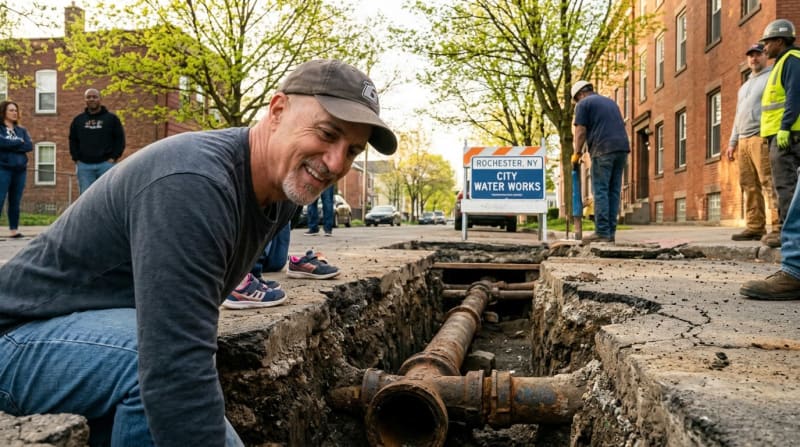
Lead service lines were standard practice in American plumbing for most of the 20th century, right up until the federal government banned them in 1986. Before that date, installing lead pipes to connect homes to municipal water mains was not negligence — it was code. Which means that in older cities like Rochester, the legacy of that era runs beneath every street in neighborhoods built before 1986.
According to the EPA, lead pipes, faucets, and plumbing fixtures are the most common source of lead in drinking water — not the source water itself, not the treatment process, but the last stretch of pipe between the main and your faucet. Water from Hemlock Lake, by the time it leaves the filtration plant, contains no detectable lead. What can happen in the distribution system, particularly in older homes, is corrosion of lead service lines that leaches into the water before it reaches the tap.
Here is how the primary sources of lead in household drinking water break down, per EPA documentation:
The NRDC has documented that upstate New York cities — including Rochester — have among the highest concentrations of pre-1986 lead service lines in the Northeast. This is not a reflection of negligence by the city. It is the arithmetic of industrial-era construction: the older the housing stock, the more likely the presence of lead service lines.
The health stakes are not abstract. The EPA is explicit: there is no safe level of lead exposure for children. Even low-level exposure is associated with reduced IQ, behavioral disorders, and developmental delays. For pregnant residents, lead exposure carries additional risks to fetal development. This is not a matter of precaution versus pragmatism. It is settled public health consensus — which is exactly why the federal government has acted.
The Lead Pipe Replacement Program: What $29 Million Is Fixing
In March 2026, Rochester secured $29 million in federal and state funding directed at two distinct parts of the water system — lead service line replacement and upgrades to the Hemlock filtration plant. This is not a single project. It is a coordinated investment in both ends of the delivery system: the source-side infrastructure that has always been Rochester's strength, and the distribution-side infrastructure that has been its vulnerability.
Based on available reporting, the investment is split between pipe replacement and plant upgrades, addressing both the last-mile problem at residential service lines and the long-term treatment capacity at the source:
Under the EPA's 2024 Lead and Copper Rule Revisions, all water utilities are now required to replace every lead service line within 10 years. The clock started in 2024. The federal compliance target is 2034. Rochester's $29 million investment positions the city to meet — and potentially exceed — that mandate without waiting for a crisis to force action.
One question residents reasonably ask: if a lead service line runs from the city main to a house, who owns the section on private property — and who pays to replace it? Historically, the portion from the main to the property line has been the city's responsibility, while the section from the property line to the home has been the homeowner's. Federal funding under the current program is directed at covering both portions, removing the financial barrier that has slowed replacement in other cities. Residents should confirm their specific situation directly with the City of Rochester water department.
How to Find Out If Your Home Has Lead Pipes

How to Find Out If Your Home Has Lead Pipes
The City of Rochester maintains a service line material inventory — required under the EPA's Lead and Copper Rule Revisions — that records the material type for lines throughout the city. To find out whether your address has a lead service line on record, contact the Bureau of Water directly through the city water quality page or call the department. Some lines are listed as "unknown material," which means an inspection may still be warranted even without a confirmed lead designation.
If you want a direct measurement of what is coming out of your tap, you can request a water test. The city offers testing assistance, and independent certified labs in Monroe County conduct residential water quality testing for a modest fee. Testing matters most in homes built before 1986, homes that have had recent plumbing work (which can disturb accumulated sediment), and homes with children under six or pregnant residents.
While waiting for replacement or test results, three interim steps make a meaningful difference, per EPA and CDC guidance:
Flush first. Before using tap water for drinking or cooking — especially after water has been sitting in pipes overnight — run the cold tap for 30 to 60 seconds. This clears standing water that has been in contact with any lead-containing plumbing.
Filter it. A pitcher or faucet filter bearing NSF/ANSI Standard 53 certification for lead reduction is highly effective. Look specifically for NSF 53 — not all Brita or PUR models carry the lead-reduction certification, so check the label before buying.
Use cold water for drinking and cooking. Hot water leaches significantly more lead from pipes than cold. Never use hot tap water for infant formula.
Here is how those interim measures compare in approximate effectiveness:
What This Means for Rochester's Future

What This Means for Rochester's Future
Lead service line replacement is an equity issue before it is an infrastructure issue. The highest concentrations of pre-1986 housing — and therefore pre-1986 plumbing — are in Rochester's older residential neighborhoods, many of which are also the city's lower-income communities. The children most at risk from lead exposure are concentrated in exactly the neighborhoods where replacement has historically moved slowest.
The $29 million investment, deployed with attention to where the risk is highest, has the potential to address not just a plumbing problem but a health equity gap that has compounded for decades. That requires deliberate prioritization, not just efficient contracting.
The comparison to Flint and Newark is worth making precisely. Both cities experienced lead crises not primarily because of old pipes, but because of decisions — Flint's source water switch that corroded the distribution system, Newark's delayed response to known contamination. Rochester's situation is different: the source water has never been the problem, the treatment infrastructure is strong, and the city is investing proactively before a crisis rather than in response to one. That matters. It is the difference between preventable harm and remediation after the fact.
"The infrastructure is always simpler than we think it is. The pipes already exist. The funding has arrived. What's left is the decision to show up for every neighborhood equally."
Rochester is, at this moment, positioned to do lead pipe replacement right — with federal backing, proactive disclosure, and a source water asset that most cities would trade almost anything to have. The gap between Hemlock Lake and the oldest pipe in the oldest neighborhood in this city is closable.
The Inner Loop removal, [Vision Zero, and now the water infrastructure investment](/rochester-is-tearing-out-the-inner-loop-north-and-it-cant-happen-soon-enough) — these are three pillars of a city remaking its relationship to its own built environment. Each one is a bet on the people who live here. Each one says something about what Rochester believes its residents deserve.
What would it mean to reach 2034 having replaced every lead service line — knowing that every child in every Rochester neighborhood has water as clean at the tap as it is at the source?
That outcome is possible. The work has started. The water is already exceptional.
Content ID: bGwLEVu6KkpAw2nLVxXktq0t
See an error? Tell us.



Comments
Share with the Community