ESL Ballpark and the Bet Rochester Is Making on Itself
The Short Version
- ESL Ballpark is getting a $65 million renovation, and this piece explains what that money is actually for and what it means for the city.
- The ballpark has been a gathering place for Rochester families since 1996, when the Red Wings moved downtown from Silver Stadium on Norton Street.
- The renovation is part of a larger 15-item Rochester-Monroe wish list to Albany totaling nearly $500 million — the ballpark is one piece of a much bigger bet.
- This piece connects the stadium story to the High Falls question, the waterfront investment, and what it looks like when a mid-sized city decides to believe in itself.
- It is also personal — Adam has been going to games there across three generations, and this piece does not separate the two things.
A Stadium That Holds More Than Baseball
A Stadium That Holds More Than Baseball
I was at Silver Stadium in the summer of 1988 when the Grateful Dead played there on June 30th — the summer after I graduated high school. The place was a minor league ballpark on Norton Street — concrete and bleachers and a hand-operated scoreboard — and it somehow held all of that. Baseball games with my dad going back years before that. Then one night, Garcia on the same grass where the Red Wings played. Rochester has always been good at that: fitting more meaning into a place than the place was designed to hold.
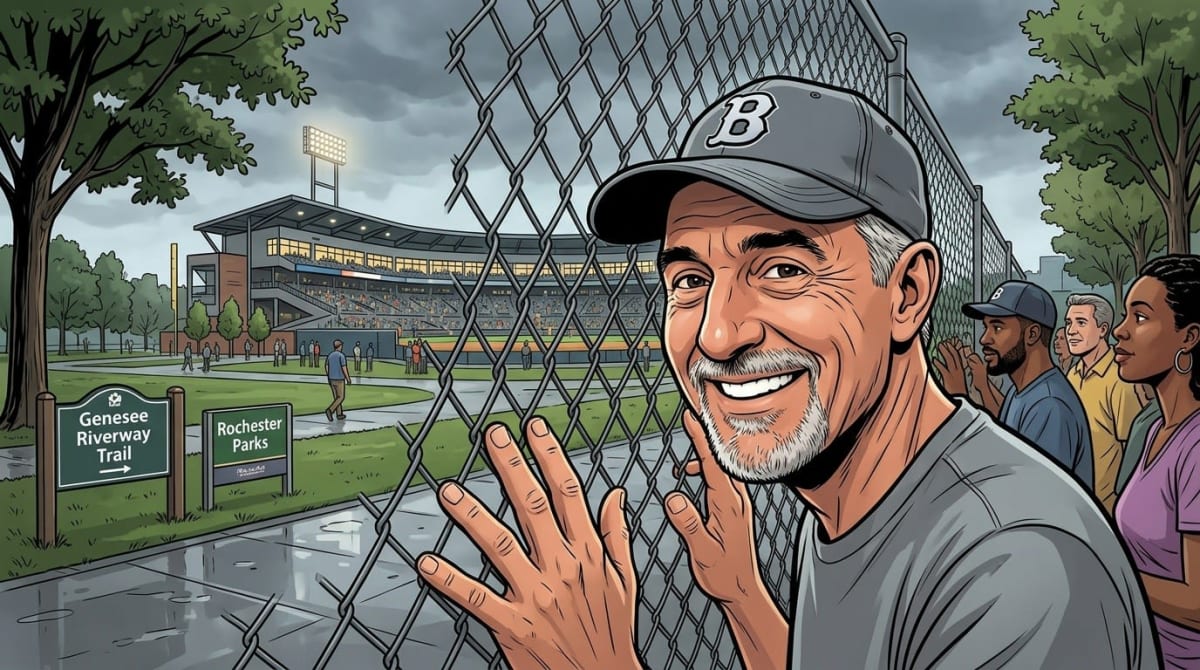
Silver Stadium closed after the 1996 season. The Red Wings moved downtown to what was then called Frontier Field, and the city got something it hadn't had before — a modern ballpark tucked against the edge of downtown, with the skyline visible from the upper deck. I moved back to Rochester in 2009 and the ballpark became a regular part of life again, this time with my kids. Father's Days with three generations. My dad, me, my kids, my sisters and their kids. Dipping Dots in the little plastic helmets. Running out onto the field to play catch on Father's Day — a tradition at the ballpark that never gets old. I have pictures from those evenings that I still look at.
The stadium has had a few names since then. Frontier. Innovative. Now, as of this season, ESL Ballpark. The name on the facade changes. The thing the place does for a community does not.
What $65 Million Is Actually For

What $65 Million Is Actually For
The home opener this afternoon — March 31, 2026, 4:05pm against the Scranton/Wilkes-Barre RailRiders — comes with more than the usual opening-day optimism. Rochester and Monroe County are in active pursuit of $65.7 million in stadium improvements, with $59 million of that being sought from the state. (WXXI News, March 2026)
The list of what that money would buy is worth reading carefully, because it tells you what the ballpark currently lacks. A wrap-around concourse that would let fans walk the full perimeter and watch from the outfield — something most newer Triple-A parks already have. A permanent, year-round events space that doesn't disappear when baseball season ends. Renovation of the historic firehouse on-site into a museum or restaurant. A new press box. Updated suites that have never been renovated since the stadium opened. And full replacement of the original seats — every one of them dating back to 1996. (WXXI News, March 2026)
Red Wings president, CEO and COO Naomi Silver put it plainly: fans have been to other facilities, they see the wraparound concourse, they sit on a blanket in the outfield. If you want to keep a stadium alive and relevant, you have to keep up. The county has owned this building since it opened, and the basics have been maintained — $12 million in MLB-required investments, another $11 million in facility improvements in recent years — but the bigger-ticket work has been deferred. Now, Silver says, the mayor and county executive have made stadium funding their number one priority for the first time. (WXXI News, March 2026)
The Bigger Picture: A 15-Item Wish List
The Bigger Picture: A 15-Item Wish List
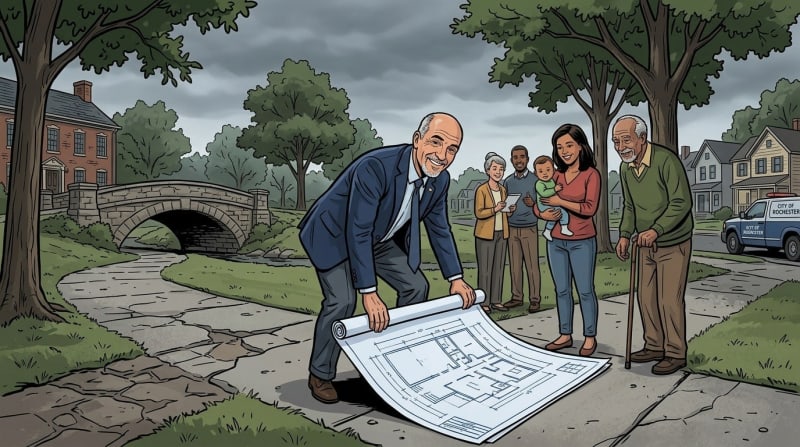
The stadium ask is one piece of a much larger proposal. Gov. Kathy Hochul pledged $225 million earlier this year toward what's being called the Rochester Monroe Transformation Initiative — a 15-item project list covering investments across the city. (WXXI News, February 2026)
The list ranges from relatively modest improvements, like concessions and restrooms at the Roc City Skate Park, to genuinely ambitious ones: riverfront restoration at the former Vacuum Oil site, a $23 million overhaul of the Inner Loop North corridor, emergency communications infrastructure, and an unspecified investment in the soccer stadium complex — with language about bringing professional soccer back to Rochester. (WXXI News, March 2026)
Rochester Deputy Mayor Michael Burns pointed to Buffalo, which is pursuing a new soccer facility for a USL Championship launch in 2027, and noted Rochester already has the infrastructure. The prospect is real enough to be on the official list. Whether it moves beyond aspirational language depends on what the state budget ultimately delivers — and that budget, as of this writing, is running late again. (WXXI News, March 2026)
The High Falls Question
The High Falls Question
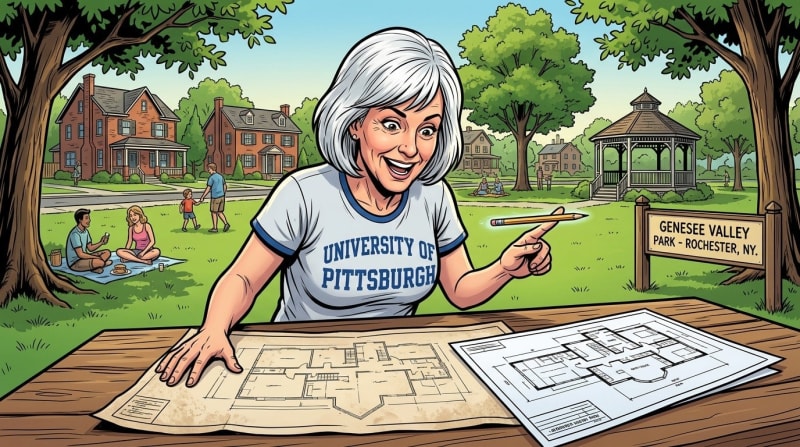
Rochester has been here before. In the early 2000s, the city tried to turn the High Falls District into a dining and entertainment destination. The investment was real. The market wasn't. The retail struggled, the restaurants came and went, and what filled the buildings instead were apartments and offices — not what the plan envisioned, but not nothing either.
Naomi Silver raised that history herself, without being asked. She said she wants to see the market studies, wants assurances that what's proposed is what the market can actually support. "Change is good," she said. "I just can't let anything negatively affect the ballpark or our fans." (WXXI News, March 2026)
The most ambitious element of the current vision is something called the Stadium District at High Falls — a proposal to develop the sea of parking lots surrounding ESL Ballpark and north of the old Eastman Kodak complex into an actual neighborhood, with new streets, housing, a concert venue, and parking structures. Christa Construction has been lobbying for the concept; the city describes it as a long-range plan. No project cost is assigned yet. No funding request has been made. Deputy Mayor Burns called the possibilities "endless," which is either exciting or a warning sign depending on your disposition toward Rochester's development track record. (WXXI News, March 2026)
What the Ballpark Has Always Been

What the Ballpark Has Always Been
Here's what I know from thirty-plus years of showing up at this stadium in its various forms: a ballpark works because it is a place where time moves differently. Three hours on a Tuesday evening in July, with your dad and your kids and a bag of peanuts and a team that probably isn't going to win the championship — and it doesn't matter. The thing that matters is that you were all there together.
That is what ESL Ballpark has done for Rochester since 1997. That is what Silver Stadium did before it. No naming rights deal changes it, and no renovation plan threatens it. The real question in all of this — the $65 million, the $225 million, the Stadium District vision — is whether Rochester can build something around that anchor that adds to it without overwhelming it. Silver's caution is the right instinct. So is the ambition. Rochester is a city that has learned, sometimes painfully, the difference between a plan and a place. The bet being placed right now is that this time, they're building both.
The opener is today. Go get a Dipping Dot.
Content ID: wpnsnBzntA117onHfapzFUTI
See an error? Tell us.

1 Comment
Dave Hope
Here we go again. Shades of the ersatz "Tall Ship", the ferry to Toronto, unused bike paths, mythical "river walks" (deteriorating after ONE year of installation), deserted Downtown, ever-increasing closed storefronts on Monroe/ Park/ South Clinton and now, ANOTHER rejuvenation plan? Just what income base is going to support any of this? Has disposable income suddenly materialized in Rochester? The largely empty brutalist blocks covering the ex-inner loop and the deteriorated downtown end of East Avenue should be cautionary tales... Another planning/development boondoggle is the last thing Rochester needs to waste time and money on.
May 27, 2026 at 8:03 pm
Share with the Community