
Rochester's R-Future Fund: What It Is, Who Qualifies, and How to Make It Grow
The Short Version
- Every Rochester City School District kindergartener automatically receives a $20 R-Future Fund savings account — no application, no income test, no paperwork required from families.
- Children with any dedicated college savings account are 3–4 times more likely to enroll in college and 4 times more likely to graduate, according to Prosperity Now — the balance matters far less than the account's existence.
- Low-income children with a savings account are more likely to enroll in college than middle-income children without one, inverting the typical relationship between family income and educational attainment.
- At $10 a month added to the $20 seed over 13 years at 3% annual growth, a child's R-Future account approaches $1,900 by age 18 — modest consistency compounds meaningfully.
- Rochester joins more than 100 child savings account programs operating nationally, including programs in San Francisco and Maine that have tracked results for over a decade.
There's a moment on the first day of kindergarten — somewhere between the backpack drop-off and the first circle time — when a five-year-old becomes, in some small way, a member of something larger than their family. A classroom. A school. A city. This fall, every child making that crossing through a Rochester City School District door also becomes something else: the owner of a savings account, opened in their name before they know what savings even means.
That's the Rochester R-Future Fund. If you've heard the name but not yet the details, here's what matters.
What the R-Future Fund Is and How It Works
What the R-Future Fund Is and How It Works
Every child enrolled in kindergarten at a Rochester City School District school receives an automatic R-Future Fund savings account seeded with $20. No forms from parents required. No income threshold to clear. No application deadline to miss. As reported by Rochester Beacon in June 2026, the program was designed with a specific intention: to build financial equity by giving every Rochester child the same financial starting point, regardless of family circumstances.
The $20 isn't meant to pay for college on its own. Nobody's claiming that. What that $20 does — and this is what the research keeps showing — is plant a flag. According to Prosperity Now, one of the country's leading organizations tracking child savings policy, children who know they have a dedicated savings account are 3 to 4 times more likely to enroll in college than children without one. The graduation numbers are even stronger: 4 times more likely to complete a degree. The balance is almost beside the point.
Here's how those findings stack up:
For program administration specifics — which financial institution holds the accounts, how interest accrues, and what the city's long-term funding plan looks like — the City of Rochester's program office is the right source as the program develops through its first full year.
What the program is saying, in terms Rochester parents and neighbors will recognize: we started something for your child before you had to ask.
Who Qualifies and How to Confirm Your Child's Account
Who Qualifies and How to Confirm Your Child's Account
The eligibility rule is about as simple as a government program gets: if your child is entering kindergarten at a Rochester City School District school this fall, they're in. That's the entire requirement.
Enrollment is automatic. There's no application for families to file, no deadline to track, no paperwork to assemble before September. The account opens on the city's side. That design is deliberate — opt-in programs, however well-designed, consistently fail to reach the families who most need them. Complicated processes sort people out by burden. Rochester removed the burden.
To verify that your child's account was created, or to learn how to access it, contact the Rochester City School District directly or reach out to the city's financial programs office. As the R-Future Fund operates through its first full year, account verification information will reach families through the district's standard communication channels — the same places you hear about enrollment, events, and available services.
If your child is starting at an RCSD school this fall and you haven't heard anything about the fund yet, that's not cause for concern. The program is new. A call to your school's family liaison or the district's central office will get you an answer.
What does a family need to do right now? Enroll in RCSD kindergarten. Everything else follows from that.
How Families Can Add to the Fund

How Families Can Add to the Fund
The $20 seed opens the account. What happens after is where the real possibility lives.
Families can add to their child's R-Future account over the years between kindergarten and high school graduation — thirteen years is a meaningful window, and compound growth rewards consistency even at small amounts. Assuming a conservative 3% annual return, the math is worth running:
For specifics on how to contribute — how deposits work, whether employer match programs or community giving options will be available, and what the account can be used for when a child turns 18 — the City of Rochester's program office is the place to check as those details are confirmed. Many child savings programs nationally allow funds to be used not just for four-year college but also for community college, vocational training, and other post-secondary paths. How Rochester's program defines eligible uses is worth confirming directly.
The question worth sitting with isn't just what a family can add. It's what it means for a child to arrive at eighteen with money already saved and a lifetime of having been told, in the most concrete terms possible, that someone was already planning for their future.
Why Child Savings Accounts Work — and What the Research Shows
Why Child Savings Accounts Work — and What the Research Shows
The case for programs like the Rochester R-Future Fund doesn't rest on compound interest math. It rests on something harder to quantify and more durable.
Prosperity Now has documented outcomes of child savings account programs for decades, across different program designs and different communities. The finding that holds across the research: children who know they have a dedicated college savings account are 3 to 4 times more likely to enroll in college and 4 times more likely to graduate — even when the account holds very little. Researchers describe it as "college-saver identity" — the psychological shift that happens when a child internalizes the idea that they are already the kind of person who prepares for college. That identity, once formed, changes behavior across years. It shapes what classes feel worth taking, what futures feel reachable, what a parent signals at the dinner table.
"The balance matters less than the belief — the belief, formed early, that higher education is already something you're preparing for."
The equity finding is the most striking part of the research. According to Prosperity Now, low-income children with a child savings account are more likely to enroll in college than middle-income children without one. That inverts the usual relationship between family income and educational attainment. The account does more equalizing work than income alone can do in the other direction.
What does it mean that every Rochester kindergartener now starts with that same signal — an account, a name on it, a city that opened it for them? It means the gap between what income predicts and what a child actually does has a better chance of closing here than it did last year.
Rochester Joins a National Movement: Child Savings Account Programs Across the Country
Rochester Joins a National Movement: Child Savings Account Programs Across the Country
Rochester isn't inventing this. It's joining something that has spent twenty years building an evidence base.
According to Prosperity Now, more than 100 child savings account programs now operate across the United States. The landscape includes city pilots, statewide initiatives, and programs run in partnership with schools and universities. The research behind them has accumulated alongside the programs themselves — and the consistency of the findings is now hard to dismiss.
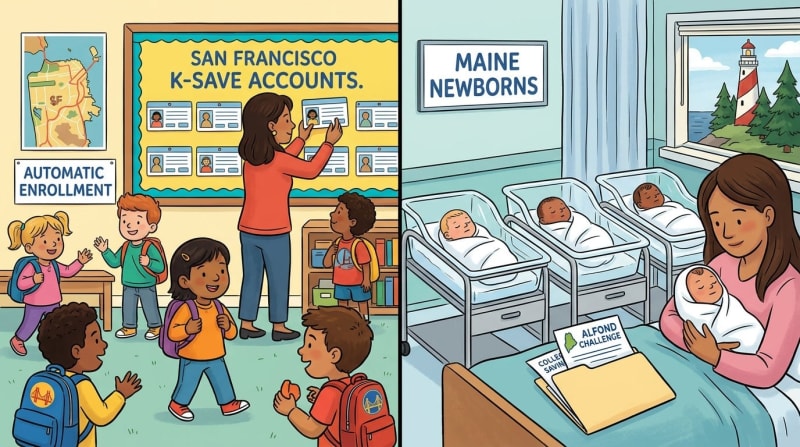
San Francisco's Kindergarten to College program, launched in 2011, was among the first universal, automatic CSA programs in the country — every kindergartener in the district, automatically enrolled, no paperwork from families. Maine's Alfond College Challenge seeds an account for every child born in the state. Promise Indiana ties savings accounts to community college scholarships as part of a broader regional economic development strategy.
Rochester's $20 starting deposit is on the modest end of what programs nationally have offered. Advocates who have worked on child savings policy for years are clear-eyed about that — and equally clear that the amount isn't the point. Universal enrollment, automatic accounts, no family left out by a complicated process: those are the design features that drive outcomes. The $20 is where the commitment starts. What gets built on top of it — by families, employers, community organizations, and the city — is the part still being written.
What would it look like for Rochester to grow this fund into something that genuinely changes what's possible for a generation of children in this city? That question is now open in a way it wasn't a year ago. And it started, this fall, with twenty dollars.
Content ID: i0RddjBc7E9TKZBimaku4z1E
See an error? Tell us.


Comments
Share with the Community