
The Maplewood Neighborhood Rochester Doesn't Talk About Enough
The Short Version
- Maplewood is Rochester's second-largest neighborhood at 3.4 square miles — home to 20,700 residents with a median age of 33, average mortgage $200 below the Rochester average, and a vacancy rate that dropped from 18% in 2013 to 9.8% in 2024
- 29% of Maplewood households are foreign-born (2010-2024 average), nearly 10 points above the citywide rate — Rochester Refugee Resettlement Services manages approximately 100 units housing families from 10+ countries across the neighborhood
- The $52.9M Eastman Reserve, developed by PathStone and opened in 2020, drew 700+ applicants to its initial waitlist and has since spurred visible home improvement activity across surrounding blocks
- The Maplewood Nature Center — part of an $11M+ investment in Lower Maplewood Park — broke ground in August 2025 and is expected to open spring 2026, with partners including RCSD, RMSC, Seneca Park Zoo, and the University of Rochester
- Eastman Business Park, which built the neighborhood and still employs 6,000+ people, reported $1.069 billion in revenue in 2025 and recently completed a cGMP pharmaceutical facility — its recovery is a slow but ongoing factor in Maplewood's trajectory
- Frederick Law Olmsted designed Maplewood Park in the 1890s; the neighborhood accounts for roughly half of all trees in Rochester's northwest quadrant and hosts a rose garden that draws visitors from across the region every June
There is a gorge in the northwest corner of Rochester that most people in the city have never walked. It sits at the eastern edge of the Maplewood neighborhood, where the Genesee River cuts through limestone and the Lower Falls drop forty feet into a canyon lined with hemlocks. Frederick Law Olmsted — the same man who designed Central Park — built a park above it in the 1890s. The rose garden there draws visitors from across the region every June. Wedding photos, graduation portraits, families from a dozen countries sitting in the same grass on the same sunny afternoon.
This is Maplewood. And if you don't know it well, you're missing one of the most quietly remarkable neighborhoods in Rochester.
What the Maplewood Neighborhood Rochester Is — By the Numbers
What the Maplewood Neighborhood Rochester Is — By the Numbers
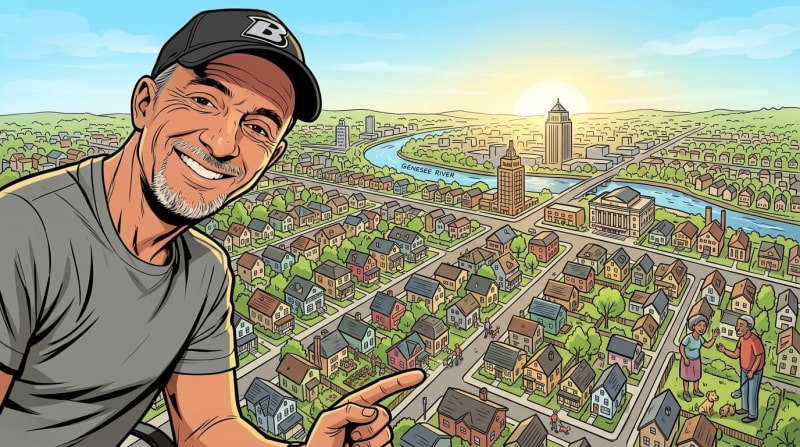
Maplewood is Rochester's second-largest neighborhood geographically — 3.4 square miles in the city's northwest quadrant, bordered by Holy Sepulchre Cemetery to the north, the Genesee River to the east, Driving Park Avenue to the south, and the town of Greece to the west. As of 2024 it has about 20,700 residents, slightly younger than the city as a whole — median age 33 versus 34 citywide.
The data portrait is one of affordability and diversity. The average monthly mortgage on a Maplewood home runs about $200 below the Rochester average. Rents average roughly $967 a month, compared to $1,105 citywide. For buyers historically shut out of the market — first-time homeowners, buyers of color, newcomers — those numbers create an opening that doesn't exist in most of the city. According to Christopher Thomas of New 2 U Homes, a broker who specializes in helping marginalized buyers into homeownership, Maplewood is one of the few places in Rochester where buyers in the $150,000-$200,000 range can genuinely compete.
What does it mean to a neighborhood when people who want to stay can actually afford to?
The vacancy rate tells the story as well as anything. In 2013, 18% of Maplewood's residential units sat empty. By 2024 that figure had been cut nearly in half, to 9.8%. That's not a coincidence — it's a decade of investment, institution-building, and new residents choosing to stay.
New Americans and the Quiet Rebuilding of a Neighborhood

New Americans and the Quiet Rebuilding of a Neighborhood
Maplewood rose with Eastman Kodak. The Kodak Business Park opened in 1890, and for decades the neighborhood was a residential hub for the company's managers and workers — its Victorian and Craftsman housing stock, many of the best examples still standing today, is a direct legacy of that era. When Kodak declined, Maplewood declined with it. Population peaked above 25,000 in the 1950s and 1960s, slid toward the low 19,000s by 2000, and the vacancy rate climbed as absentee landlords moved in and properties deteriorated.
What reversed that trajectory wasn't a single development project. It was people.
From 2010 to 2024, an average of 29% of Maplewood households were foreign-born — nearly ten points above the citywide average of 20%. Refugee resettlement has been a particularly significant driver. Rochester Refugee Resettlement Services, founded by Mike Coniff and now led by executive director Djifa Kothor, has grown over 14 years to manage approximately 100 housing units in Maplewood, sheltering families from Burundi, Bhutan, Congo, Ethiopia, Myanmar, Somalia, Sudan, South Sudan, Syria, and Vietnam.
That diversity shows up in the day-to-day texture of the neighborhood. A Congolese grocery on Dewey Avenue. Nepali families in the rose garden. Multilingual conversations in the library. Forty-two percent of all Maplewood households speak a language other than English at home — in the neighborhood's southern section, that figure rises to 81%.
"If people want to see a mini-world, they can go visit Maplewood," says Bijaya Khadka, a 13-year neighborhood resident who came to the United States in 2009 after being born to parents from Bhutan in a Nepali refugee camp, and now serves on the New American Advisory Council. "They will see people from all over the world living in this small neighborhood."
The Investments That Are Changing What Maplewood Looks Like

The Investments That Are Changing What Maplewood Looks Like
Three physical investments — one recently completed, one opening this spring, one ongoing — are reshaping the neighborhood's built environment in ways that will compound over the next decade.
The Eastman Reserve. Developed by PathStone Corporation and opened in 2020, the $52.9 million mixed-income development converted an abandoned Kodak parking lot into 187 rental units across 17 buildings. It was the first large-scale residential development at Eastman Business Park in decades — and the community demand was immediate. According to HUD's case study of the project, more than 700 applicants were on the initial waitlist. Since completion, home improvement activity has increased visibly across the surrounding blocks — the kind of ripple effect that's easy to see and hard to quantify.
The Maplewood Nature Center. In August 2025, Mayor Malik Evans joined city and state officials to break ground on three simultaneous capital projects in Lower Maplewood Park: a new Nature Center converting a 1945 building into a hub for environmental education, an inclusive playground with a sensory component designed for children on the autism spectrum, and Genesee Riverway Trail upgrades connecting Lower Falls Park to the Maplewood Rose Garden. Total investment: more than $11 million in city, state, and federal funds. Completion target: spring 2026. Community partners include the Rochester City School District, Rochester Museum and Science Center, Seneca Park Zoo, and the University of Rochester.
Eastman Business Park's quiet comeback. The 1,200-acre park that built Maplewood isn't dormant. Kodak reported $1.069 billion in revenue for 2025 — a 2% increase over 2024 — and remains the region's third largest manufacturer with 1,300 local employees. A new cGMP pharmaceutical manufacturing facility at EBP recently completed construction. The park employs over 6,000 people total and is actively in discussions with developers about additional residential development on the site. What happens at EBP has always shaped what happens in Maplewood. That connection is still live.
What would it mean for Maplewood if EBP's next chapter looks anything like its first?
The Neighborhood That Gets Less Press Than It Deserves

The Neighborhood That Gets Less Press Than It Deserves
"I find people who don't know about it are always shocked at how beautiful Maplewood is," says Bill Collins, president of the Maplewood Neighborhood Association. "I think the southeast tends to get more press, and the other quadrants are less publicized unless something bad happens. There's a lot they're missing when they do that."
He's not wrong. The conversation about Rochester's revitalization tends to center on the East End, the Inner Loop East corridor, and downtown development. Those are real and important stories. But Maplewood's version of the same story — driven less by a single investment catalyst and more by the accumulation of families choosing to stay and institutions choosing to invest — is unfolding in parallel and getting a fraction of the attention.
The Maplewood Community Library offers English language and citizenship courses, job application support, and after-school childcare — it functions as a first-stop integration resource for new Americans in a way that goes well beyond book lending. The Maplewood Family YMCA has served the neighborhood since 1916. The Maplewood Neighborhood Association holds monthly town halls at Aquinas Institute, keeps a community garden on Lexington Avenue, and runs historical gorge tours that regularly leave first-time visitors stunned by what's been there all along.
Maplewood makes up a third of Rochester's northwest quadrant but accounts for roughly half of all trees in the quadrant. Two well-serviced bus lines run along Dewey and Lake avenues. The rose garden peaks in June.
None of this requires a ribbon cutting. It's just there, if you go looking.
Content ID: V82WkJKw7qHpvFRB47Y0HrDk
See an error? Tell us.

Comments
Share with the Community