Downtown Rochester Is Getting a Grocery Store Again
The Short Version
- Aker Club, a small-format neighborhood grocery from founder Zachary Harper, will open at 255 East Main Street in Sibley Square — the same space DGX vacated in March 2025
- COMIDA unanimously approved a $28,169 sales tax exemption on April 21 toward a nearly $500,000 renovation including refrigeration and self-checkout
- Downtown Rochester has nearly 11,000 residents and a Transit Center serving 40,000+ daily riders directly across the street — a customer base that did not fully exist when Hart's Local Grocers closed in 2019
- Hart's closed five years before the Inner Loop East fill-in and Sibley Square residential boom reached full effect — Aker Club arrives into a meaningfully denser downtown
- Inner Loop North, funded with $100M in January 2025 and slated to break ground in 2027, will reclaim 22 acres for redevelopment — adding another wave of downtown density after Aker Club opens
- The last full-service downtown grocery anchor — the Wegmans inside Midtown Plaza near the bus station — closed when the plaza was demolished starting in 2010
The Number 1 bus used to drop you right at Midtown Plaza. My grandmother never drove a car a single day of her 96 years, and she never needed to — not for groceries, anyway. We'd ride down together, do a loop through the plaza, and end up at the Wegmans tucked near the bus station end before heading home. It was an ordinary thing. That's the point. A downtown Rochester grocery store was just part of how the city worked.
When Midtown closed and that Wegmans went with it, something specific was lost — not just a store, but a kind of mobility. The idea that you could live downtown, or visit downtown, without a car and still feed yourself.
The Wegmans Inside Midtown Plaza That My Grandmother Never Had to Drive To

The Wegmans Inside Midtown Plaza That My Grandmother Never Had to Drive To
There is a version of downtown Rochester that most people under 40 have never experienced — one where the central business district functioned like an actual neighborhood. Midtown Plaza, which opened in 1962 as the first enclosed urban shopping mall in the United States, was the anchor of that version. The Wegmans inside it was not a destination. It was infrastructure.
When Midtown closed in 2008 and demolition began in 2010, the grocery question became urgent. Nearly 11,000 people live in downtown Rochester, and for transit-dependent residents — people like my grandmother in her day, or like the 40,000+ riders who pass through the RTS Transit Center directly across from Sibley Square every single day — the absence of a walkable grocery store is not an inconvenience. It is a structural problem.
What does it cost a city, over years and decades, when the people who live at its center cannot buy food without a car?
What We Lost When Hart's Closed — and Why the Timing Was Wrong

What We Lost When Hart's Closed — and Why the Timing Was Wrong
Hart's Local Grocers was supposed to be the answer. It opened in 2014 at 10 Winthrop Street on the East End, a genuine independent grocery with local sourcing and a community-first vision. I met with Glenn, the founder, a number of times before he launched — he was looking for investors and feedback, and I was running a business off University Avenue with 30 employees and actively involved in advocacy around the downtown food desert. The vision was right. The timing was hard.
Hart's closed in 2019 after five years, citing declining sales. What felt like defeat at the time looks different now. The Inner Loop East fill-in project, which began converting the sunken highway into walkable urban blocks starting around 2017, has since catalyzed a wave of residential development across the East End — more than $200 million in investment and 500+ housing units according to the city's own accounting. The apartments that might have sustained Hart's were still being built when the doors closed.
It was, I think, five years too early.
A neighborhood grocery store is not just a business. It is the difference between a place people live and a place people pass through.
DGX — Dollar General's small-format play at urban retail — occupied the space at 255 East Main Street in Sibley Square from December 2020 until March 2025. Anyone who walked in hoping to cook dinner went home disappointed. A bag of chips and a bottle of bleach is not a food system.
Who Aker Club Is and What Zack Harper Is Building

Who Aker Club Is and What Zack Harper Is Building
Zachary Harper is a Rochester native who spent 15 years living abroad, including time in Europe, before returning to the city. He moved into a downtown apartment and found himself unable to buy groceries within walking distance. The frustration was personal and practical — and it pointed at an opportunity.
His concept, Aker Club, is a small-format neighborhood grocery modeled on what Harper experienced in European cities: stores that are modest in size, well-stocked for daily needs, and embedded in the fabric of where people actually live. On April 21, COMIDA — the County of Monroe Industrial Development Agency — unanimously approved a $28,169 sales tax exemption on materials for a nearly $500,000 renovation of the former DGX space. The build-out includes refrigeration equipment and self-checkout kiosks.
Unanimous approval. That detail matters. This is not a contested project. It is a city saying yes to something it has been waiting seven years to say yes to.
The numbers tell the story. The residential base that was not quite there when Hart's opened has been building steadily for a decade. Aker Club is arriving into a downtown that has meaningfully more people in it than the one that could not sustain Hart's.
Why This Time Feels Different

Why This Time Feels Different
Four things are true now that were not fully true in 2014.
First, the Inner Loop East fill-in is complete and its residential ripple effect is real — new apartment buildings have changed the density math on the East End and along Main Street. Second, Sibley Square itself has transformed — 280 apartments in the building alone, a food court, a theater, consistent investment from WinnCompanies making it a functioning mixed-use hub rather than a struggling mall. Third, Harper comes to this with a specific vision shaped by experience, not just optimism — he has seen what small neighborhood grocery stores actually look like when they work.
And fourth: Inner Loop North is coming. In January 2025, the U.S. Department of Transportation awarded Rochester $100 million through the Reconnecting Communities Pilot Program — one of the largest grants in the program's history — to remove the remaining northern segment of the expressway. Construction is expected to begin in 2027. When complete, it will reclaim approximately 22 acres of land, roughly 14 of which are identified for potential redevelopment, reconnecting downtown with the Public Market, High Falls, and surrounding neighborhoods. If Inner Loop East catalyzed $200 million in investment on one side of downtown, Inner Loop North stands to do the same on the other.
Aker Club will be open before a single shovel hits the ground on Inner Loop North. The residents it needs to survive are already there. The ones who will follow are already in the pipeline.
The Transit Center across the street serves more than 40,000 riders a day. Every one of those riders is a potential customer who can stop on the way home. That is not a niche market. That is a neighborhood.
Will the East End density that has arrived since Hart's closed be enough to sustain what Hart's could not? That is the real question — and nobody can answer it yet.
What a Neighborhood With a Grocery Store Actually Means
What a Neighborhood With a Grocery Store Actually Means
My grandmother never thought of the Wegmans at Midtown as a community amenity. It was just where you went. That is the thing about infrastructure that works — it disappears into the background. You stop noticing it because it is simply there.
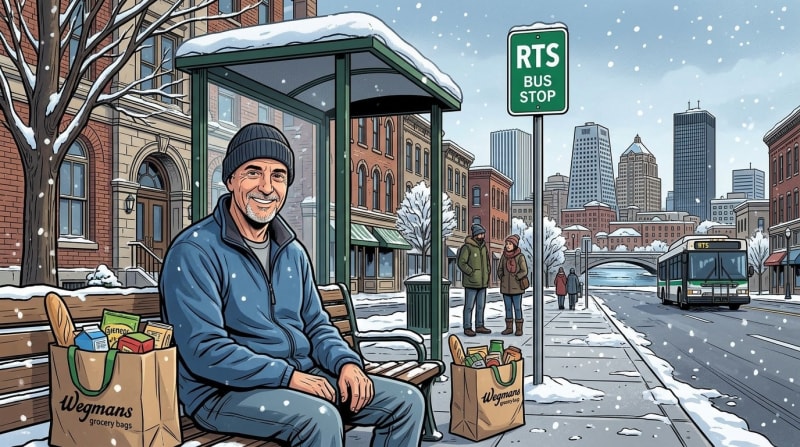
Downtown Rochester has been noticing its absence for a long time. The people who rode the Number 1 bus and could not stop for groceries on the way home. The residents who moved downtown for the energy and the walkability and then drove to Wegmans in Pittsford anyway. The transit riders who told WHEC this week that a grocery store at Sibley would let them stop before catching the bus home — a small thing that turns out to be not small at all.
Aker Club is not a guaranteed success. Retail is hard, grocery is hard, and downtown Rochester has the receipts to prove it. But the conditions are better than they have been at any point since Midtown closed. The residents are there. The transit infrastructure is there. The building is there. And with Inner Loop North on the horizon, the neighborhood that Aker Club needs is still growing.
What is missing is the store. And someone is finally building it.
Content ID: notRZspXOxXQHhfJUhfmzCOQ
See an error? Tell us.

Comments
Share with the Community