
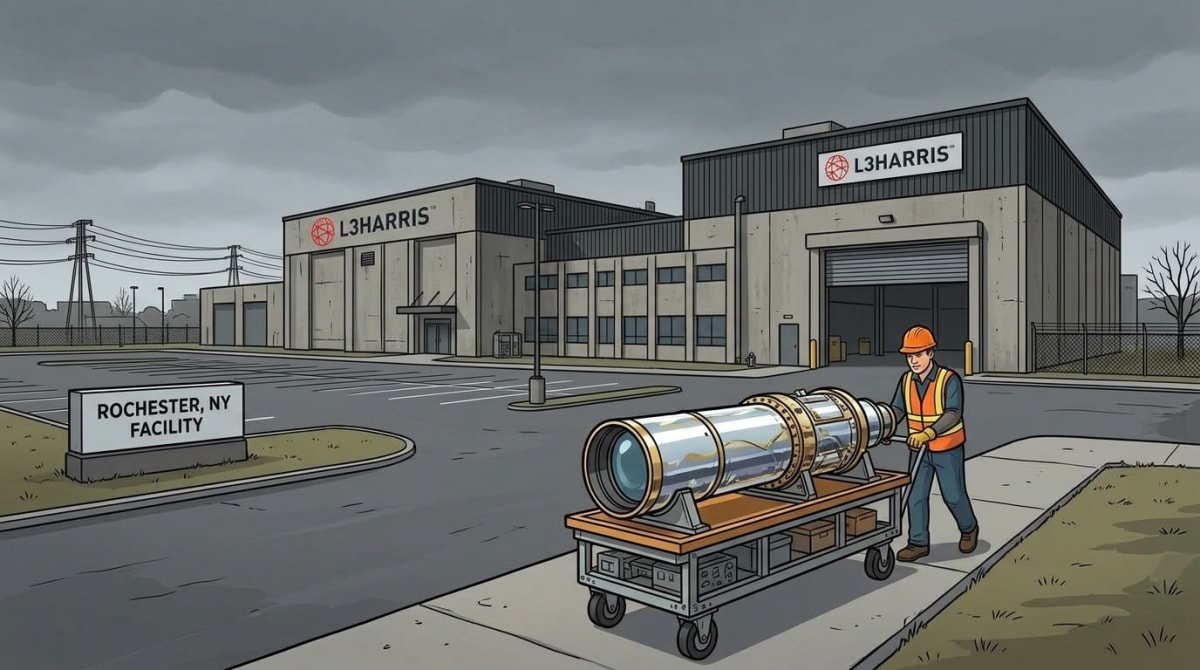
Rochester Is Building the Eyes of NASA's Gravitational Wave Observatory
The Short Version
- L3Harris Technologies in Rochester has been awarded a NASA contract to build the Engineering Test Unit telescope for LISA — the critical step that proves out production before flight hardware is manufactured.
- The LISA constellation spans 2.5 million kilometers and will detect gravitational waves at milliHertz frequencies no ground-based observatory can reach.
- Each of the three LISA satellites carries two ceramic-glass telescopes; L3Harris already delivered a full-scale prototype now at NASA's Goddard Space Flight Center.
- LISA launches in 2035, and the Engineering Test Unit Rochester is building now is the foundation the mission's flight hardware will rest on.
- Rochester's precision optics lineage runs from Bausch & Lomb through Eastman Kodak to L3Harris — LISA is where that tradition is pointed right now.
Rochester has been building precision optical instruments for space since before the Space Shuttle flew. The latest contract — L3Harris Technologies in Rochester selected by NASA to build the Engineering Test Unit telescope for the LISA gravitational wave observatory — is the kind of work this city was built to do.
What LISA Is Designed to Hear
What LISA Is Designed to Hear
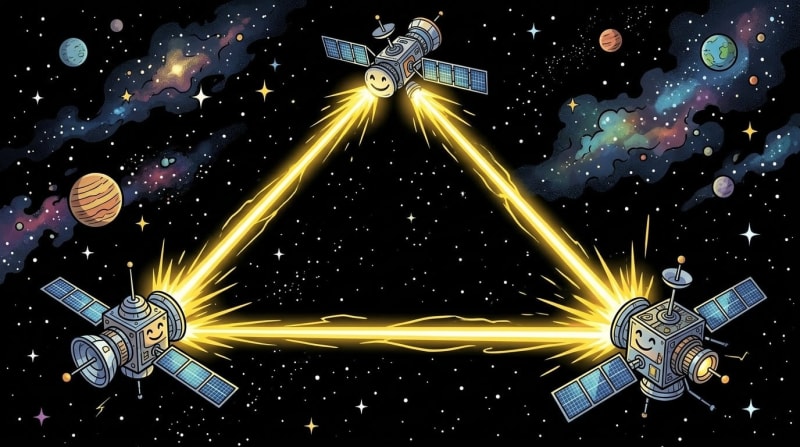
Gravitational waves are ripples in space-time produced when black holes collide, when neutron stars merge, when something massive enough distorts the fabric of the universe. Ground-based observatories like LIGO have detected them, but only at frequencies their land-based instruments can reach. LISA goes after the milliHertz range: slower, deeper signals from supermassive black holes and binary star systems that have been circling each other for millions of years — frequencies no ground-based detector can touch.
The LISA mission, led by the European Space Agency with NASA as a major partner, is slated to launch in 2035. Three satellites fly in a triangular formation in heliocentric orbit, separated by 2.5 million kilometers. Laser beams pass between them continuously. The instrument measures the changes in those distances — changes smaller than the width of a single atom. That level of precision demands optics that are essentially perfect.
Rochester's Role: The L3Harris NASA Telescope Contract
Rochester's Role: The L3Harris NASA Telescope Contract
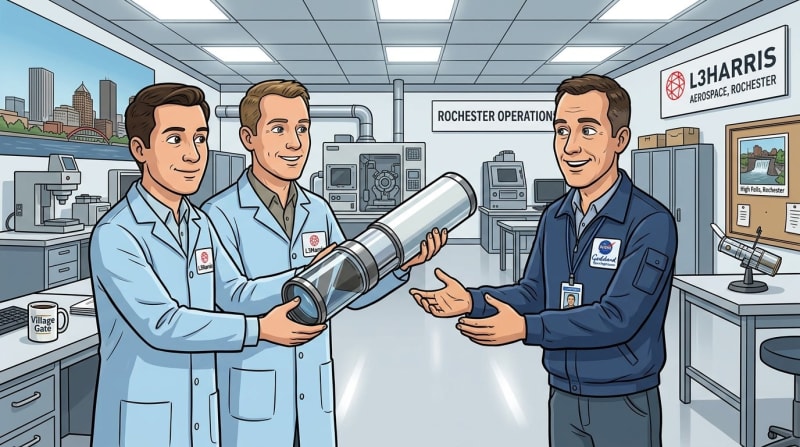
NASA awarded L3Harris Technologies in Rochester the contract to design, assemble, integrate, and test the Engineering Test Unit telescope — the step that bridges prototype development to full flight hardware production. Each of the three satellites will carry two ceramic-glass telescopes, transmitting and receiving the laser beams that do the actual measuring across millions of kilometers.
Rochester has already delivered on this mission once. L3Harris built and delivered a full-scale prototype telescope now guiding development at NASA's Goddard Space Flight Center in Maryland. The Engineering Test Unit contract builds directly on that work: the Rochester team applies what they learned from the prototype and constructs the test article that proves out the full production process before flight hardware is manufactured.
What This Means for Rochester
What This Means for Rochester
L3Harris is one of Rochester's anchor employers, and its roots run through the entire history of Rochester optics — from Bausch & Lomb to the University of Rochester's Institute of Optics to the precision manufacturing firms that have operated in Monroe County for over a century. LISA is not a departure from that tradition. It is the current leading edge of it.
The people doing this work may be building components that will fly 2.5 million kilometers apart, but they are doing it in the same precision optics tradition that cut lenses for Eastman Kodak and ground mirrors for observatories around the world.
"LISA will open a new window into the universe that ground-based observatories cannot access."
— Jeff Hanke, President of Space Systems at L3Harris
LISA continues that work into the 2030s, with the Engineering Test Unit phase beginning now and the mission launching in 2035.
Content ID: DZwyBJroTBurloPnCzwwB3HW
See an error? Tell us.



Comments
Share with the Community