Rochester Pedestrian Safety: Why the SUVs and Trucks on Our Streets Are Deadlier Than You Think
The Short Version
- At 20 mph, a sedan strike produces survivable injuries in crash simulation; a tall-hooded truck or SUV at the same speed produces catastrophic or fatal ones — same speed, entirely different physics.
- IIHS research confirms pedestrians struck by SUVs and pickup trucks are two to three times more likely to die than those struck by passenger cars at comparable speeds.
- Light trucks went from roughly 37% of US new vehicle sales in 2000 to 80% by 2023 — the vehicle doing the most pedestrian damage is now the dominant vehicle on the road.
- Rochester's Vision Zero Phase 2 focuses on speed, but the truck-height research adds a second variable the city's crash data may not currently track: what class of vehicle was involved.
- Local advocates and residents can make a specific ask of city government: begin tracking vehicle type at pedestrian crash incidents — that data changes where infrastructure dollars go.
The number that stopped me reading the New York Times investigation published June 22 wasn't a fatality count. It was a height: 50 inches. That's where the hood of a large truck starts — and it turns out that measurement is the difference between a pedestrian walking away from a collision and not walking away at all. SUV and truck hood heights are reshaping pedestrian safety on Rochester streets in ways that most of us driving Monroe Avenue and Park Ave every day have never had a name for — until now.
What the New Investigation Found — The Hood Height Problem
What the New Investigation Found — The Hood Height Problem
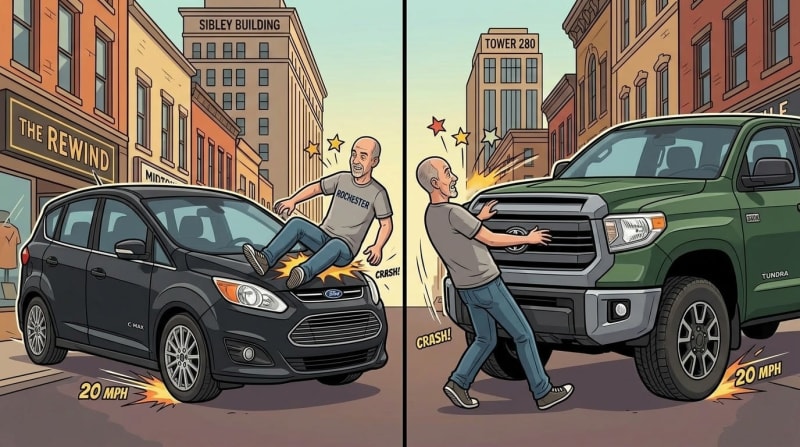
On June 22, reporters at The New York Times published one of the more consequential pieces of transportation journalism in recent years. Using crash-reconstruction simulations conducted with safety experts, they found something engineers have known for years and regulators have largely not acted on: vehicles with hoods above 50 inches are dramatically more lethal to pedestrians than smaller cars, even at the exact same impact speed.
The comparison at the center of the investigation is straightforward and alarming. The hood of a 2014 Ford C-Max — a compact sedan — starts at 31 inches. The hood of a 2017 Toyota Tundra starts at roughly 50 inches. When both vehicles strike a pedestrian at 20 miles per hour, the outcomes in simulation are not similar. The sedan produces survivable injuries. The truck produces catastrophic or fatal ones.
Times reporter Sam Sifton wrote from his own experience as a truck driver:
"Trucks like mine, a Times investigation has found, are far deadlier than smaller cars like hers. They kill thousands of pedestrians who otherwise might have survived being hit by them."
— Sam Sifton, The New York Times, June 22, 2026
The investigation was conducted by reporters Michael H. Keller, Eli Murray, Danielle Ivory, and Irineo Cabreros using established crash-reconstruction methodology. This is not speculation. It is physics — physics that the American vehicle market has been reshaping for two decades without much public reckoning about what it means for people on foot.
Research from the Insurance Institute for Highway Safety confirms the pattern at the institutional level. IIHS has found that pedestrians struck by SUVs and pickup trucks are approximately two to three times more likely to die than those struck by passenger cars at comparable speeds. The institute also identifies front vehicle height above 40 inches as a threshold associated with significantly higher pedestrian fatality rates — a threshold that many crossovers now exceed.
What does this mean for a city that has committed to eliminating traffic fatalities entirely? That is the question worth sitting with.
How the Vehicle Fleet Has Changed on American Roads — Including Rochester
How the Vehicle Fleet Has Changed on American Roads — Including Rochester
In the early 2000s, sedans and coupes were the dominant passenger vehicles on American roads. Ford sold millions of them every year. That world is largely gone.
By 2026, SUVs and pickup trucks dominate new vehicle sales. According to the New York Times investigation, vehicles with hoods above 50 inches have increased fivefold on American roads since 2002. The broader fleet shift that drove this is tracked in the EPA's Automotive Trends Report — light trucks, the category that includes SUVs, pickups, and minivans, have risen to about 63% of new US vehicle production, surpassing cars.
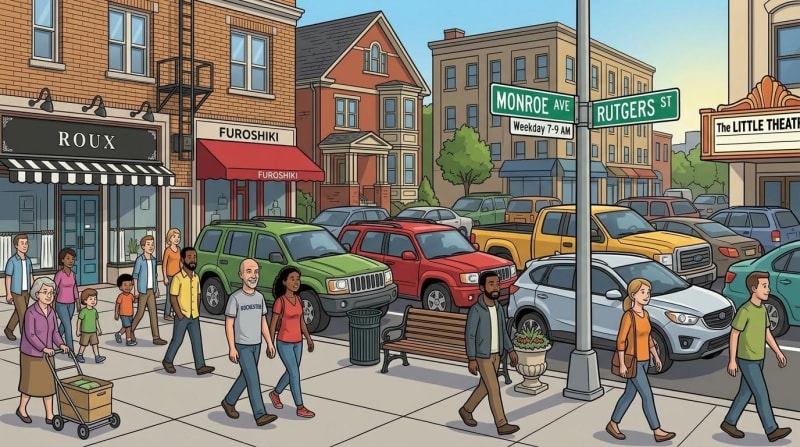
This is not a fringe trend or a regional quirk. The vehicle that federal regulators have done almost nothing to constrain in terms of pedestrian lethality is now the default American automobile. Drive Monroe Avenue on any weekday morning and watch what goes past — pickups, three-row SUVs, crossovers stacked three lanes deep. Rochester is not different from the national pattern. Our pedestrian corridors, our residential neighborhoods, our school zones have the same vehicles moving through them.
The pedestrians on those sidewalks have not changed. They are still the same height they have always been.
What This Means for Pedestrian Safety in Rochester and Vision Zero
What This Means for Pedestrian Safety in Rochester and Vision Zero
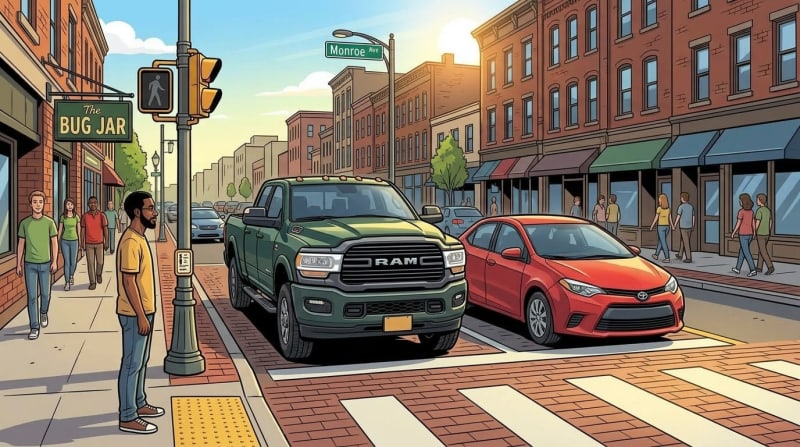
Rochester has a Vision Zero commitment. Phase 2 of the initiative focuses on speed enforcement cameras and physical infrastructure improvements on known high-crash corridors. That work matters and deserves community support. Speed reduction saves lives across every vehicle class.
But the NYT investigation adds a dimension to Rochester's pedestrian safety picture that the Vision Zero framework hasn't explicitly addressed: speed and vehicle height are two separate variables. The city's program has focused — reasonably — on speed as the primary lever. The hood-height research means that even at the speeds Vision Zero is trying to achieve — 20 to 25 miles per hour — a tall-hooded vehicle striking a pedestrian produces a fundamentally different outcome than a sedan at the same speed.
This doesn't undermine Vision Zero. It complicates it in a useful way. The relationship between speed and pedestrian fatality is steep regardless of vehicle type, and slowing vehicles down remains the right goal. According to traffic safety research compiled by IIHS:
Getting Rochester's pedestrian corridors to 20 miles per hour is still the right priority. What the truck-height research adds is a second axis that Rochester's crash data collection may not currently track in any systematic way: what class of vehicle was involved in each pedestrian incident?
Reconnect Rochester has been one of the most consistent local voices for pedestrian-scale street design and sustainable transportation in this region for years. The truck-height research strengthens that case with specific, independently replicated findings. It belongs in the conversations happening at the city level about where infrastructure dollars go and what corridors get prioritized.
Does Rochester's Vision Zero team currently know what percentage of the city's pedestrian fatalities involved SUVs or pickup trucks versus smaller vehicles? If that data isn't being systematically collected, the NYT investigation gives the city a concrete reason to start.
The Physics of Why Hood Height Matters So Much
The Physics of Why Hood Height Matters So Much
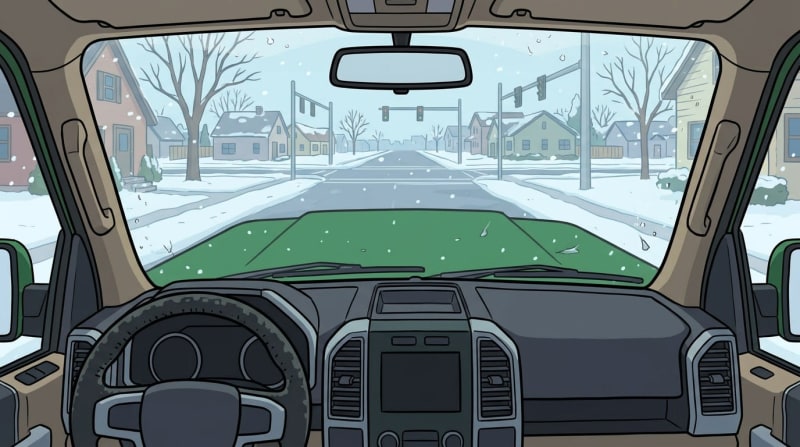
The crash-reconstruction community has a name for the way a low-hooded vehicle interacts with a pedestrian in a collision: the wrap. A sedan's hood catches a pedestrian at the legs. The pedestrian's body rotates forward and up onto the hood — a pattern that distributes impact energy across a larger surface and is, in many circumstances, survivable.
A tall-hooded truck or SUV produces no wrap. The hood contacts the pedestrian at chest or abdominal height. The pedestrian goes straight back or, in some configurations, underneath the vehicle. The energy transfer is concentrated rather than distributed. The outcomes — in simulation and in the real-world crash data — are dramatically worse.
Here is how the hood heights of common vehicles compare, using data from the New York Times investigation:
Blind spots compound the problem in a way that should concern every parent watching a child cross the street in front of a large truck. Vehicles with higher hood lines also have significantly larger front blind zones. A child standing directly in front of a large pickup truck is, in many cases, completely invisible to the driver until the vehicle is already in motion. People in wheelchairs face the same invisibility — their entire body may sit below the hood line of the vehicle approaching them.
This is not an edge case. It is the physics of vehicles that now dominate American roads, operating on streets that were not designed for them.
What Rochester Residents and Advocates Can Do With This Information
What Rochester Residents and Advocates Can Do With This Information
There is a version of this article that ends in despair — about the scale of American trucks, the slowness of federal safety regulation, the distance between what the research shows and what actually changes. That is not the version worth writing. The NYT investigation is sobering, but it is also clarifying. Here is what it makes possible.
Infrastructure advocacy becomes more specific. Pedestrian islands, raised crosswalks, and speed tables are not just abstract traffic-calming measures — they force vehicles to slow at exactly the points where pedestrian-vehicle conflicts are most likely. When a large pickup truck has to reduce speed to navigate a raised crosswalk, the physics of a potential impact shifts meaningfully toward survivable. Rochester's Vision Zero Phase 2 infrastructure investments are worth pushing forward and worth expanding to every corridor where pedestrian and vehicle traffic share space.
Vision Zero data collection can improve, and community members can make the ask directly. Does Rochester track vehicle type at pedestrian crash incidents? If the answer is no, the research gives a concrete reason to start. A city that knows whether the majority of its pedestrian fatalities involve tall-hooded vehicles is a city that can make better decisions about where its infrastructure dollars go and what design standards it requires.
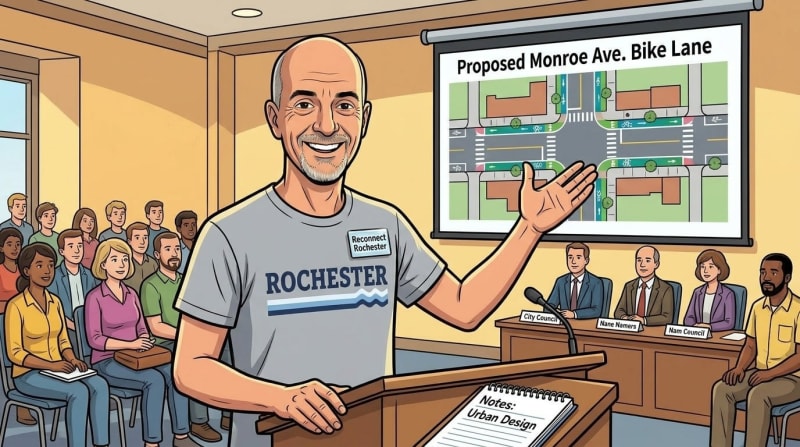
Reconnect Rochester has been building the case for pedestrian-scale street design in this city for years — showing up at planning meetings, advocating for corridors, keeping the long-term safety conversation in front of city government when it would be easy for it to slide off the agenda. That sustained local advocacy is the mechanism through which national research becomes local policy change. The truck-height data is a new and powerful tool for exactly that work.
Personal vehicle choices carry weight too — the part of this conversation that is hardest to say plainly. Understanding that driving a large pickup truck on urban streets carries real consequences for neighbors on foot is part of being a responsible member of a city. Not a condemnation. A fact that this investigation makes harder to set aside.
The streets of Rochester belong to everyone who uses them — the person walking to the bus stop on Monroe Avenue, the kid crossing toward school on Park Ave, the neighbor navigating the East End in a wheelchair. What would it look like for our city to take the truck-height research as seriously as we've taken the Vision Zero speed data — and to build a pedestrian safety picture that accounts for both?
Content ID: WE7do8onQxGlSL5CsqWCUb9D
See an error? Tell us.

Comments
Share with the Community